The essential difference
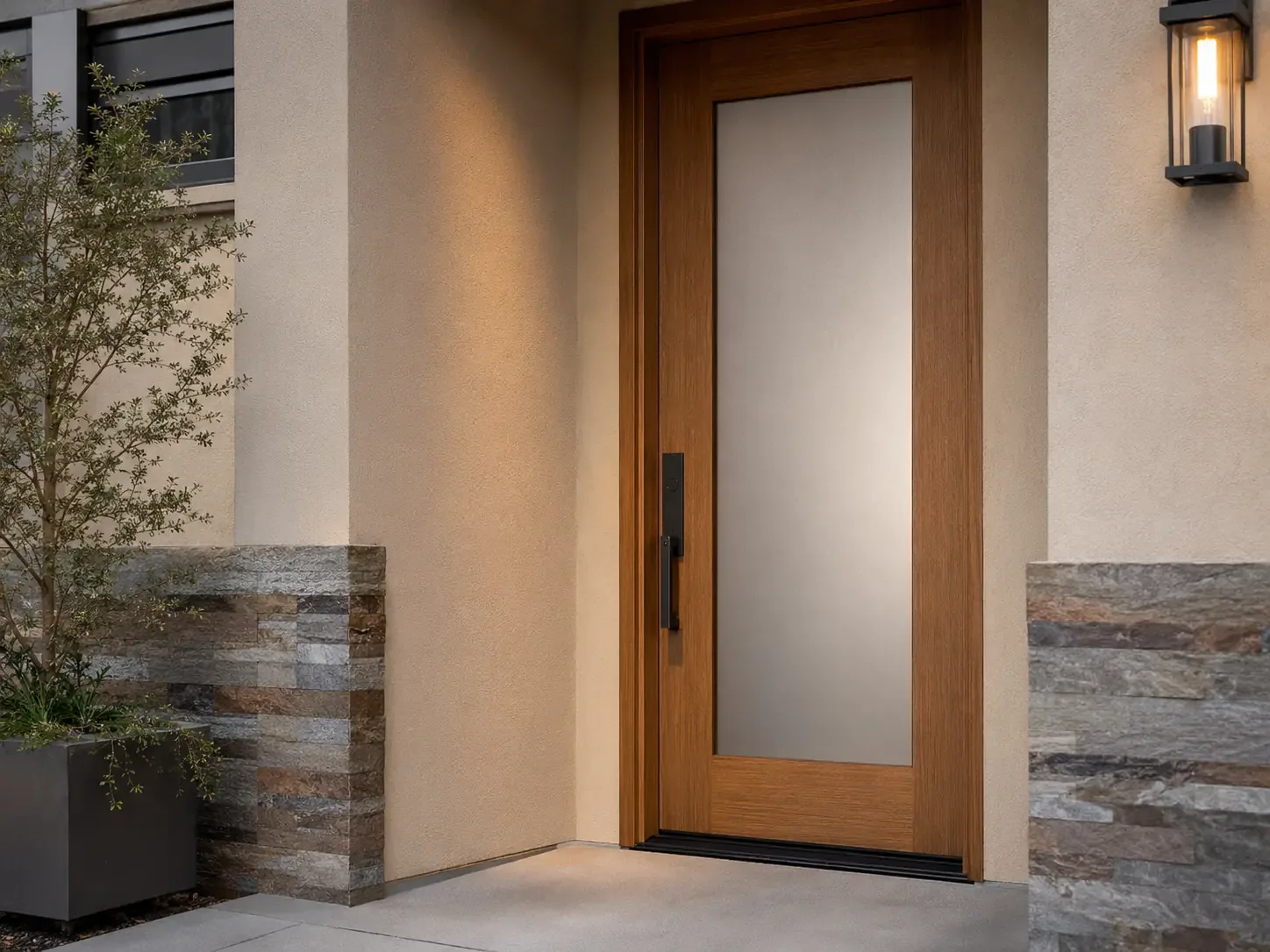
Frosted glass has a continuously obscured appearance. Switchable smart glass has an electrically controlled transparent state and a translucent privacy state. That difference sounds simple, but it affects design, electrical coordination, fabrication, maintenance and cost. If privacy is always required and an exterior view is never important, permanent frosted glass may be the more direct answer. If the entrance is intended to feel open at selected times and private at others, smart glass offers a behavior that static glass cannot.
Neither category should be judged from a small product sample alone. Frost level, lighting and observer distance affect the visibility of shadows and shapes. Smart glass in privacy mode scatters light but is not blackout. The best evaluation uses a representative panel, realistic interior and exterior lighting, and the normal approach distance to the front door.
Privacy during the day and after dark
Permanently frosted glass provides a generally consistent obscured appearance because it does not rely on a reflective lighting imbalance. The exact privacy level depends on the finish, pattern, panel thickness and how close a person is to the glass. Some lightly etched designs are more decorative than private. A full-area translucent treatment usually screens detail more predictably than a sparse pattern.
Smart glass also provides a privacy state that is not based on creating a mirror toward the brighter side. That makes it fundamentally different from “one-way” reflective film. However, private does not mean opaque. Bright objects and people near the panel may create diffuse silhouettes. A project that requires complete darkness or zero visible movement should include a separate blackout strategy.
Daylight and the appearance of the foyer
Both options can admit diffuse daylight while limiting detailed views. Frosted glass does this continuously, softening the light and maintaining the same aesthetic throughout the day. For some architecture, that consistency is a benefit: the entry reads as a luminous surface rather than a window.
Smart glass allows the design team to choose. In its transparent state, it reconnects the foyer to the exterior and can reveal the door’s full glass composition. In its private state, the entrance becomes a light-diffusing plane. Optical expectations should remain realistic; switchable PDLC glass is not identical to ordinary clear float glass when transparent, and exact appearance depends on the selected construction, viewing angle and light.
Power and fabrication complexity
Permanent frosted glass is passive. Once a suitable safety or exterior glazing assembly is selected and installed, it does not need a transformer, switch, moving-door power transfer or control logic. This reduces coordination and removes an electrical service point. It can be attractive where the design wants privacy with minimal operational complexity.
Switchable laminated smart glass requires custom fabrication and a compatible electrical system. In a door leaf, power must move safely from the fixed frame to the moving panel through a protected method coordinated with the door construction. Sidelights and transoms are fixed, but they still need concealed wiring routes and decisions about whether they switch together or independently. Those items should be resolved before fabrication and finishing.
Cleaning, service and long-term expectations
Both finished glass surfaces need cleaning compatible with the glass, coatings, seals and surrounding frame. Textured frosted surfaces may show oils or require different care than smooth acid-etched or laminated finishes. The exact cleaning method should come from the product and door suppliers.
Smart glass adds electrical components that must remain accessible for service. The panel itself should not be treated as field-trimmable, and damaged custom glass may require replacement. A good installation records power-supply locations, circuits, control zones and wiring exits so future maintenance does not begin with destructive investigation. This documentation is part of a premium result.
Aesthetic and control considerations
Frosted glass can be uniform, patterned, sandblasted, etched or laminated with a translucent interlayer. That range supports traditional and contemporary doors without visible controls. It can also conceal the view permanently, which may be undesirable when the front garden, vestibule or exterior approach is part of the architecture.
Smart glass is most compelling where transformation is intentional. It can support a clean, modern door, an iron or steel frame, matched sidelights and transom, and scene-based controls. The control should be intuitive. A wall switch may be better than a complicated app for daily use; a broader home-control interface can be reviewed when the responsible integrator confirms compatibility.
Choose by use case
Choose permanent frosted glass when: the entry should remain private, power is undesirable, the design favors a consistent translucent look and a clear state has little value.
Evaluate switchable smart glass when: the design requires both transparency and privacy, the door or glass is new, custom fabrication is acceptable and electrical integration can be planned before the assembly is completed.
For an existing door, do not assume that retrofit PDLC film is automatically equivalent to a new laminated panel. Glass type and condition, door movement, exposure, edges, wiring and installation must be assessed. Sometimes the responsible recommendation will be to retain a passive privacy solution or replace the glazing as part of a coordinated new door.
What to include in a project brief
Provide the project location, door material, exterior or protected position, glass dimensions, sidelights or transom, desired privacy schedule, control preference and any impact or local approval requirements. State whether the door is already ordered. That timing determines which options remain realistic.
Ask each supplier to identify what is included and what is not: glass construction, door glazing, wiring, power supply, controls, electrical labor, installation, sealing, approvals and final testing. A transparent scope comparison is more useful than comparing two product labels with different responsibilities hidden behind them.
Frequently asked questions
Is smart glass better than frosted glass for a front door?
It is more flexible because it can switch, but it is not automatically better. Frosted glass is simpler when permanent privacy is acceptable; smart glass fits projects that value both clear and private states.
Can you see silhouettes through frosted or smart glass?
Silhouettes can be perceptible depending on the product, lighting and distance from the glass. Both options should be tested for the actual privacy requirement.
Does smart glass need electricity?
Yes. Switchable PDLC glass needs a compatible power and control system, including a planned transition for a moving door leaf.
Is frosted glass blackout?
No. Frosted glass generally diffuses and transmits light. A separate covering or blackout system may be needed when darkness is required.