
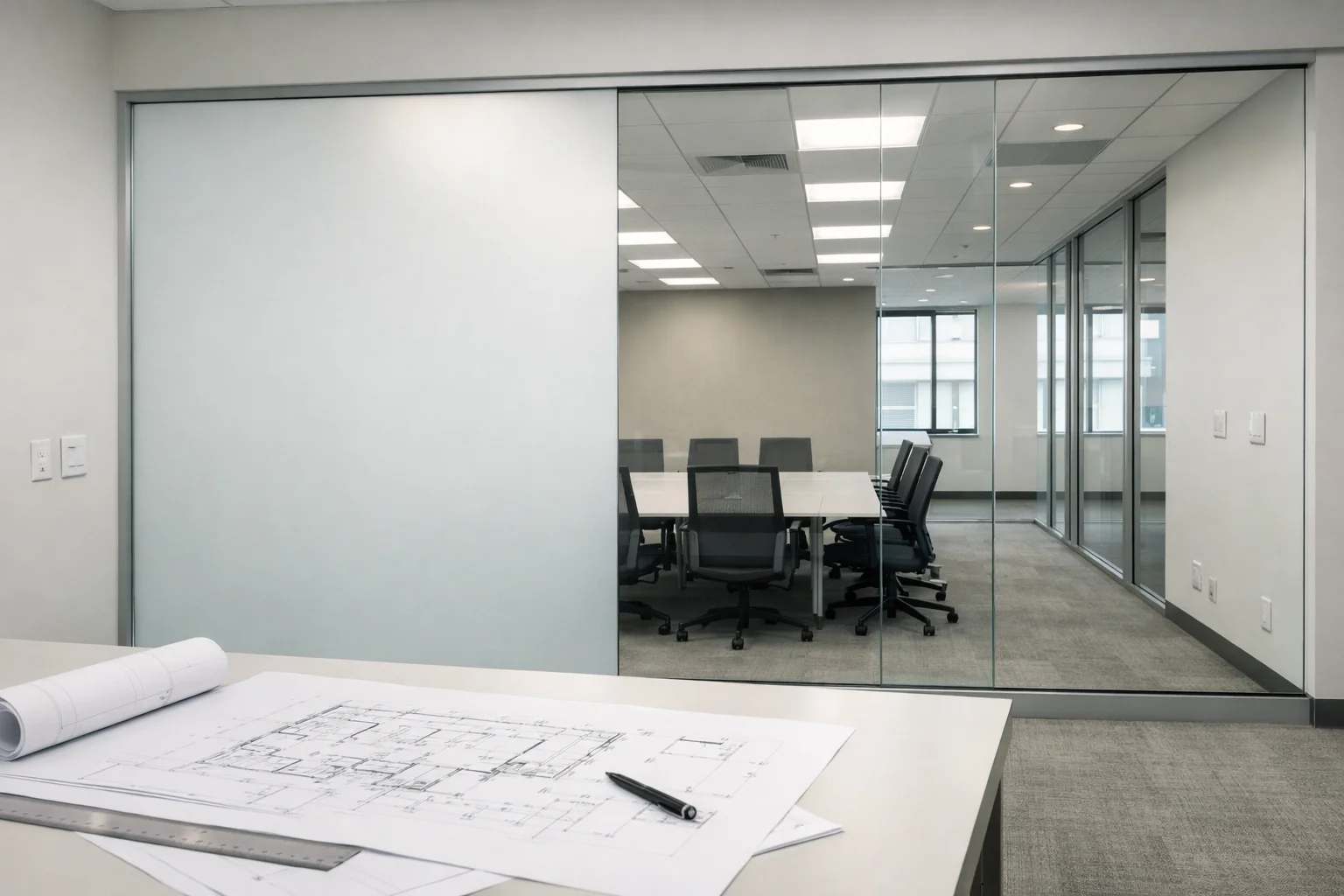
When a commercial interior includes glass offices, conference-room fronts, or other new interior glazing, switchable privacy glass is not simply a finish decision. It is a coordinated glass and electrical scope. For a general contractor or project manager, the important early question is whether the project can define the product, responsibilities, and handoff points before the relevant work is locked in.
This guide focuses on laminated smart glass for new construction or a planned glass-replacement scope. It does not address retrofit film for existing glass. That distinction matters: laminated smart glass is a fabricated glass assembly, while PDLC smart film is a different solution that may be considered for suitable existing glass.
Why early coordination matters on a switchable-glass scope
Laminated switchable privacy glass contains the PDLC layer within a fabricated laminated assembly. That can support an integrated architectural finish, but it also means the product needs to be considered as part of the glazing package rather than treated as an afterthought once standard glass is installed.
Custom fabrication, dimensions, edge details, controls, wiring, installation requirements, and lead time all need project-specific confirmation. If the privacy function is raised only after the interior glass has been ordered or installed, the team may be evaluating a different solution path, a revised scope, or a later change. Identifying the requirement early does not guarantee a particular schedule or outcome; it gives the project team time to review whether the application is feasible and how it should be coordinated.
First confirm the function: visual privacy, not every kind of privacy
Switchable privacy glass changes between a transparent state and a translucent, frosted-looking privacy state. Its relevant function is controllable visual privacy. A room may use that function when a meeting, consultation, interview, or focused activity requires people outside the room to stop seeing through an interior glass wall.
That is not the same as acoustic confidentiality, true blackout, security performance, or solar control. PDLC alone should not be specified as the answer to those separate requirements. If a room needs more than visual privacy, the design team should identify each need and evaluate the appropriate additional construction or system. A hybrid approach may be considered where privacy must be paired with a separate blackout or solar-control function.
When laminated smart glass is the relevant path
Laminated smart glass is generally the path to evaluate when a project has new interior glass, a planned glass replacement, a wet-area application, or a premium architectural scope. Because the active layer is protected within the fabricated laminated assembly, it can provide a more integrated result than an applied retrofit solution.
It is not automatically the right option for every glass partition. Existing suitable glass, limited scope, timing, and project priorities may point the team toward another approach. The purpose of early review is not to force a product choice. It is to align the intended use, the glass scope, and the coordination capacity before a decision is made.
For the broader architectural solution, review switchable privacy glass for premium architectural spaces.
A practical coordination sequence for general contractors
1. Locate the privacy moments on the plan
Ask where a transparent glass wall needs to become visually private and when that change needs to happen. This creates a usable application list for rooms such as conference rooms, executive offices, consultation areas, and selected partitions. It also helps distinguish a recurring operational need from a fixed condition that could be handled by permanent obscuration.
2. Establish whether the glazing is new or being replaced
This is the key routing question. New glazing or replacement can support review of laminated smart glass. Where glass is already installed and retained, a project may instead need an assessment of retrofit PDLC film for suitable existing glass. These products should not be treated as interchangeable assemblies.
3. Identify the responsible parties before procurement
The project team should determine who will coordinate glass dimensions and edge details, who will provide the electrical connection, how controls will be selected, and how installation sequencing will be managed. The exact division of responsibility belongs in the project review and contract documentation rather than being assumed from a general product description.
4. Review physical and electrical interfaces
Wiring, controls, transformers, sealing, glass condition where relevant, dimensions, installation method, and site conditions can affect suitability. For new laminated assemblies, coordination should also account for fabrication requirements and glazing details. Confirm these items with the appropriate project professionals before release or installation.
5. Protect the decision from scope drift
A clear project record should state that the requested outcome is visual privacy on demand. It should also state any separate needs for acoustics, blackout, security, AV, or solar control. This keeps one product function from being assumed to solve unrelated room-performance requirements.
Addressing the “unfamiliar trade” concern
General contractors often need to assess whether a specialty solution will create coordination burden or disrupt a tight sequence. The practical response is not to make broad promises about simplicity. It is to establish the handoffs early: what is fabricated, what is installed, what electrical work is needed, who verifies dimensions, and when the relevant work needs to occur.
For commercial glass contractors, partition installers, and related trade partners, an early conversation can also clarify whether the project is suitable for collaboration rather than requiring a team to assume unfamiliar responsibilities without review. Explore the SmartGlass USA Partner Program for glass dealers, installers, and fabricators for that partner-oriented discussion.
Questions to resolve before calling the scope complete
- Which rooms need visual privacy on demand, and what triggers the privacy state?
- Is the applicable glass new, planned for replacement, or already installed?
- Does the project need visual privacy only, or are acoustics, blackout, security, or solar control separate requirements?
- Have glazing details, dimensions, edge conditions, and fabrication needs been reviewed for the intended assembly?
- Who is coordinating electrical connection, transformers, wiring routes, controls, and commissioning?
- What sequencing, protection, sealing, and site-condition considerations need confirmation before installation?
These questions do not replace project documents or trade coordination. They provide a focused way to decide whether switchable glass belongs in the scope while there is still time to plan it correctly.
Discuss a new-construction privacy-glass scope
If a project has new interior glazing and a defined need for controllable visual privacy, talk to SmartGlass USA about a project. A project discussion can review the intended application, whether laminated smart glass is the relevant solution, and which glazing and electrical questions need to be coordinated. It should not be used to assume acoustic privacy, blackout, security performance, technical specifications, schedule commitments, or pricing before the project conditions are reviewed.
Frequently asked questions
Is laminated smart glass the same as retrofit PDLC film?
No. Laminated smart glass places the PDLC layer within a fabricated laminated glass assembly and is suited to new construction, glass replacement, wet areas, and premium projects. Retrofit PDLC film is a separate solution that may be considered for suitable existing glass.
What does switchable privacy glass provide in a commercial interior?
It provides visual privacy on demand by changing between transparent and translucent, frosted-looking privacy states. It does not by itself provide acoustic privacy, true blackout, a security rating, or solar-control performance.
What should a GC coordinate early for laminated smart glass?
Review custom fabrication, dimensions, edge details, glazing interfaces, wiring, transformers, controls, installation sequencing, sealing, and site conditions with the relevant project parties. Specific requirements must be confirmed for the project.