
Start with the privacy problem, not the product
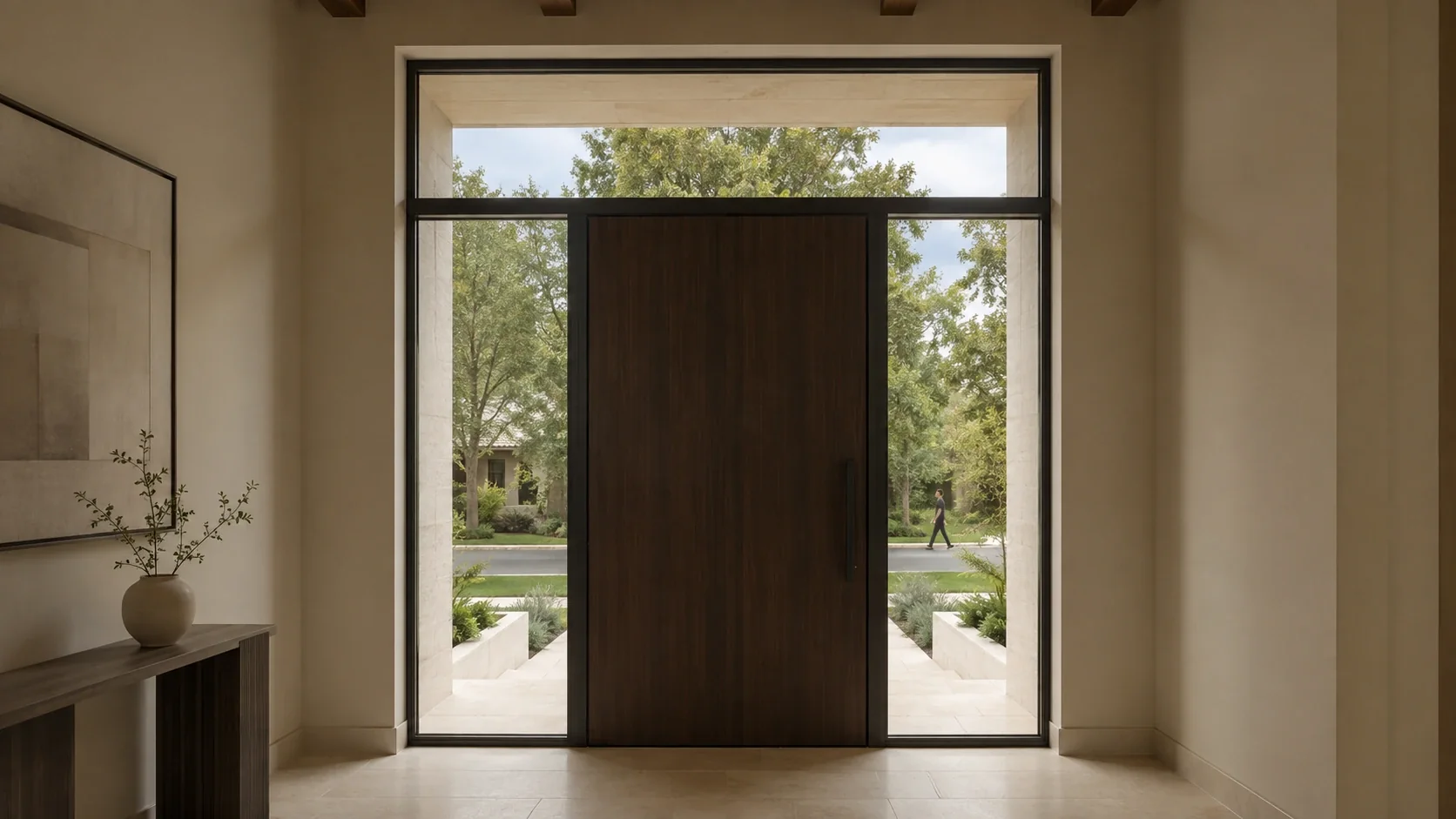
Front-door glass serves several purposes at once. It can bring daylight into a foyer, create a visual connection to the exterior and make a narrow entrance feel larger. The same transparency can reveal circulation paths, stairs, furnishings or occupants, especially when the home is brighter inside than outside. That is why a product that looks private in a daytime photograph may not solve the real evening condition.
Before comparing products, document the desired behavior. Decide whether the entrance should remain private at all times, become transparent only when requested, or simply obscure detailed views while still transmitting light. Also separate visual privacy from other requirements. Privacy glass is not automatically security glazing, impact-rated glazing, acoustic glass, solar control or blackout. A successful specification addresses each requirement independently and then coordinates them within the door assembly.
Front-door privacy options compared
| Solution | Adjustable privacy | Daylight | Night privacy | Maintenance | Best use | Important limitation |
|---|---|---|---|---|---|---|
| Switchable laminated smart glass | Yes | Retains diffuse light in privacy mode | Privacy state is not dependent on exterior brightness | Clean as specified for the finished glass; controls also need access | New or replacement glazing in a custom premium entry system | Requires fabrication, electrical planning and assembly-specific review |
| PDLC smart film | Yes | Retains diffuse light in privacy mode | Privacy state is not based on a mirror effect | Exposed film edges and surface need appropriate care | Suitable existing interior glass after condition and environment review | Not a universal retrofit for every exterior door |
| Permanently frosted or patterned glass | No | Usually retains diffuse daylight | Generally consistent, subject to pattern and proximity | Simple glass cleaning; textured surfaces may need extra care | Entries that can remain obscured all the time | No clear view on demand |
| Decorative privacy film | No | Depends on opacity, pattern and coverage | More predictable when opaque or translucent rather than reflective | Edges and surface can wear or be damaged | Budget-conscious visual screening on compatible glass | Changes the appearance continuously and may not suit all glazing |
| Reflective or one-way film | No active switching | Can reduce visible light | Often unreliable when the interior is brighter | Film surface and edges require care | Daytime screening where lighting conditions are controlled | Should not be sold as dependable nighttime privacy |
| Shade, blind or curtain | Yes | Depends on position and material | Can provide strong privacy when fully closed | Hardware and fabric require cleaning and adjustment | Conventional interiors with room for visible hardware | Can conflict with handles, door movement and a minimal design |
No single row is automatically best. A permanently frosted lite may be the most direct answer for a homeowner who never wants a view through the door. A shade may be appropriate when blackout or a soft residential finish matters more than an uninterrupted glass surface. Smart glass becomes relevant when the design intent specifically calls for a clear state and a private state in the same opening.
When switchable smart glass fits the design brief
PDLC-based switchable privacy glass changes between a transparent appearance and a translucent, frosted-looking privacy state when its electrical state changes. In privacy mode it scatters light, so the entrance can continue to receive diffuse daylight while detailed views are obscured. It is a visual privacy tool, not true blackout: silhouettes, contrast and nearby light sources can still influence perception.
For a new premium front door, replacement glazing, sidelights or a transom, a fabricated laminated smart-glass panel is usually the path to evaluate. The switchable layer is integrated into a laminated assembly, and the dimensions, edges, electrical connection and installation interface are coordinated before fabrication. The glass cannot be selected independently from the frame, door construction, movement, weather exposure and applicable local requirements.
A useful project brief identifies each lite separately. A homeowner may want the door panel switchable but the transom permanently private, or may want the sidelights controlled as one zone and the door as another. Those decisions affect wiring and controls, so they should be discussed before the door manufacturer or glass fabricator finalizes the assembly.
Where privacy film can help—and where caution is warranted
Decorative or translucent privacy film can be a practical way to screen compatible existing glass. It does not require electrical controls, and patterns can complement a residential entrance. The tradeoff is permanence of appearance: once applied, the screened area does not become optically clear on command. Samples should be viewed from both sides, in daylight and at night, before choosing the coverage and pattern.
Adhesive PDLC smart film is a different category. It adds switchable behavior to suitable existing glass and can be useful for retrofit projects, particularly interior glass. A front door is a more demanding environment because the glass, edges, wiring, door movement, solar exposure, moisture and installation details can differ significantly from a fixed indoor partition. Suitability must be reviewed rather than inferred from the fact that the surface is glass.
Reflective film deserves a separate warning. Its daytime privacy relies on a favorable lighting difference. When the foyer is bright and the exterior is dark, the visual relationship can reverse. 3M identifies its consumer solar privacy film as a daytime-privacy product and states that it does not provide nighttime privacy. That is a useful reminder to test the real lighting condition instead of relying on the label “one-way.”
Source: 3M Sun Control Window Films guidance.
Frosted glass and shades remain valid alternatives
Permanently frosted, etched or patterned glass can be the cleanest non-powered choice when a clear view is unnecessary. It avoids controls and moving hardware while allowing light to diffuse through the opening. The specification still matters: some patterns obscure detail better than others, and a person standing close to the glass may remain more perceptible than expected. Full-size samples and an evening mockup provide better information than a small swatch.
Shades and blinds provide familiar control and can offer stronger visual screening or blackout, depending on the product. Their challenges at an entry are physical. A moving door, lever, lock, closer or decorative grille can interfere with hardware. Fabric and slats can move when the door swings, and cassettes or side channels change the appearance. A shade should be coordinated with the actual door geometry, not added after the door is ordered.
Evaluate privacy after dark
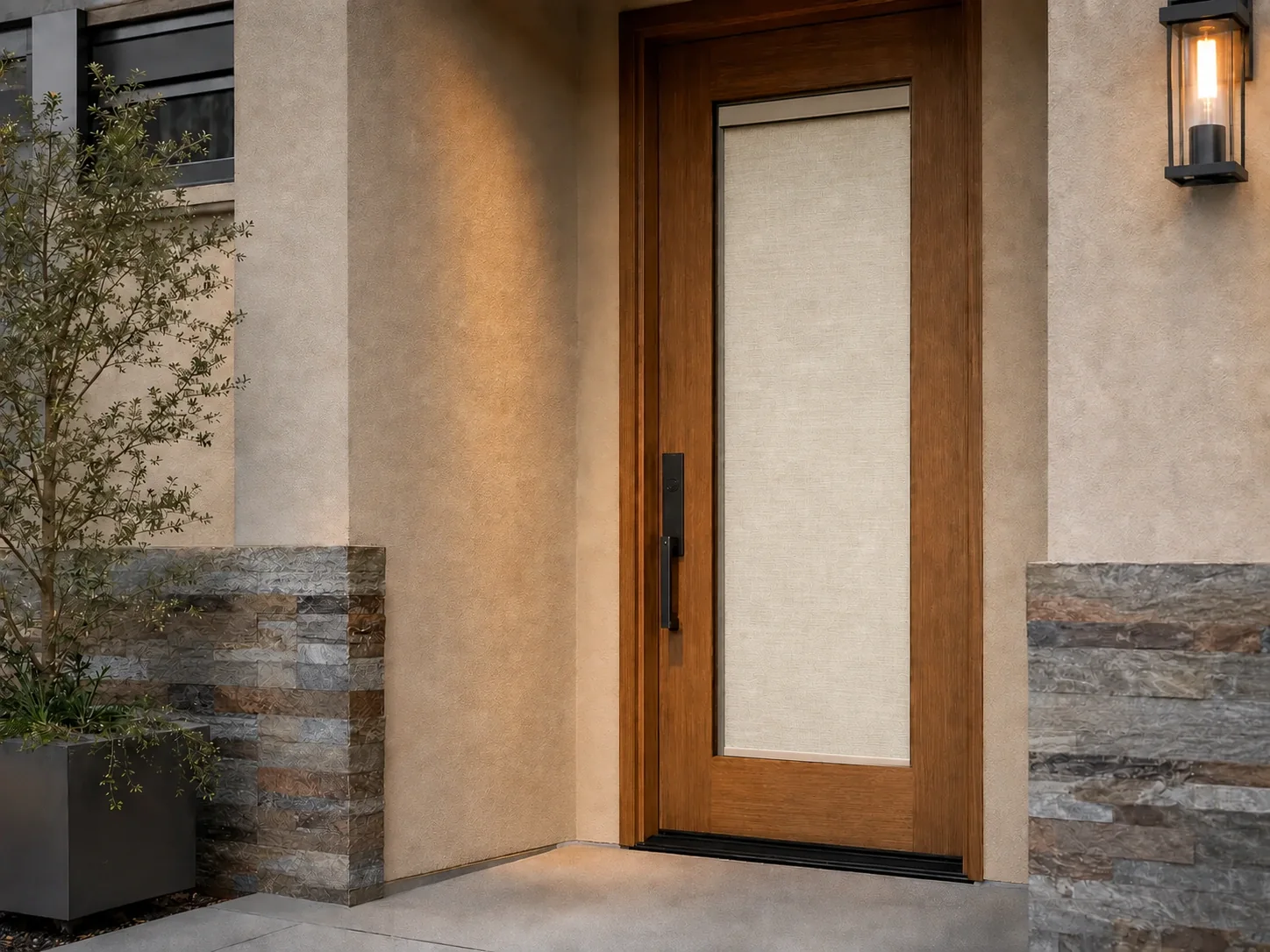
The most revealing test is simple: illuminate the foyer, stand outside at the normal approach distance and observe the glass from several angles. Repeat the test with exterior lighting on and off. If a solution depends on reflection, tint or a subtle pattern, the result may change substantially. Also test a person standing near the glass, because proximity increases the visibility of form and movement.
For smart glass, review the private state as a privacy condition rather than a blackout condition. For frosted glass or translucent film, review how much silhouette is acceptable. For a shade, confirm that the edges, bottom and hardware provide the expected coverage. The right solution is the one that satisfies the actual privacy moment while remaining compatible with the door.
A practical selection checklist
- Record whether the glazing is existing, being replaced or part of a new door.
- Identify the door material, swing, lite dimensions, sidelights and transom.
- Describe when a clear view is desired and when privacy is required.
- Test the entrance during daytime and with the interior brighter at night.
- Separate visual privacy from impact, safety, security, acoustic, solar and blackout requirements.
- Confirm whether visible hardware, film edges or electrical controls are acceptable.
- For powered glass, coordinate wiring, power transfer, transformer/control location and service access before fabrication.
- For exterior work, review the entire door and glazing assembly with the responsible door manufacturer, design professional and local authority.
Send these details at the beginning of a project review. The information makes it easier to determine whether the best next step is laminated smart glass, a film evaluation, a permanent glazing choice or a conventional covering.
Frequently asked questions
What is the best privacy option for a glass front door?
There is no universal best option. Switchable laminated smart glass fits projects that need both clear and private states; frosted glass fits continuous privacy; shades can add stronger screening; and film may suit compatible existing glass after review.
Does smart glass provide privacy at night?
Its privacy state does not depend on daylight reflection, but PDLC is visual privacy rather than blackout. Lighting, proximity and silhouettes should still be evaluated for the intended entrance.
Can smart film be installed on any front door?
No. Existing glass condition, door movement, exposure, edges, wiring, moisture and the complete assembly must be reviewed. Retrofit PDLC film is most commonly considered for suitable existing interior glass.
Does one-way mirror film work at night?
Reflective privacy depends on the lighting relationship. When the interior is brighter than the exterior, dependable nighttime privacy should not be assumed.
Is frosted glass more private than smart glass?
Both can obscure detailed views, but results depend on the product, lighting and how close a person is to the glass. Frosted glass is continuously obscured; smart glass provides an adjustable clear/private state.