
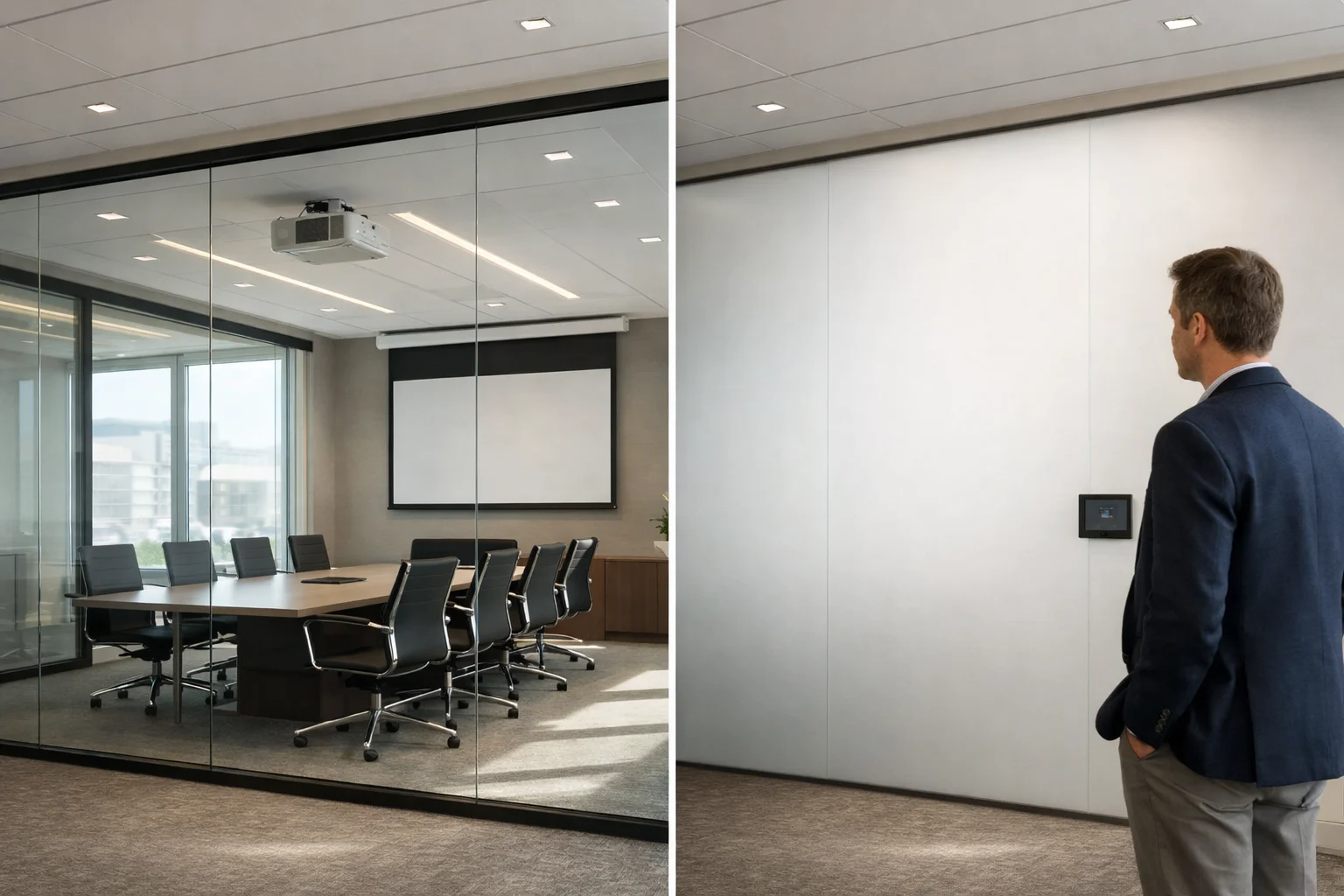
AV integrators are often involved when a client wants a meeting room, executive office, clinic, or premium residence to work as one coordinated environment. Glass walls can support an open layout, but they can also create a privacy problem. A smart glass partner program may be relevant when the project needs on-demand visual privacy and the existing glass may be suitable for retrofit.
Where PDLC smart film can fit in an AV-led project
PDLC smart film, also called switchable privacy film, changes between transparent and translucent, frosted-looking privacy states when connected to power and a control system. It can often be retrofitted onto suitable existing glass, which may avoid replacing an entire interior glass partition.
For an AV integrator, the opportunity is not to become a glass contractor. It is to recognize a privacy requirement early and help the project team determine whether a switchable privacy solution belongs in the scope. Typical discussions may arise around conference rooms, executive offices, treatment spaces, home offices, and interior glass partitions.
For a closer look at retrofit applications, see PDLC smart film for existing glass privacy.
A simple fit check before proposing smart film
A productive first conversation is less about promising a finished system and more about clarifying the application. Start with these questions:
- Is the privacy issue visual, rather than a need for acoustic privacy or true blackout?
- Is there existing interior glass that may be suitable for a retrofit?
- Can power, wiring, controls, and edge treatment be planned with the relevant trades?
- Will the location expose the film edges or wiring to conditions that require additional review?
- Is the client preserving an open glass design while needing privacy at selected times?
PDLC smart film is not blackout film, and it does not by itself provide acoustic privacy or make glass security-rated. If the project also needs solar control or true blackout, it may require a separate component such as shades, curtains, or another appropriate technology.
Why early coordination matters
Switchable privacy film requires an electrical connection and a control approach. That means the glass condition, dimensions, wiring route, transformer or control needs, edge details, installation sequence, and site conditions should be reviewed before the system is selected.
Planning these points early helps keep responsibilities clear among the AV integrator, electrical team, glass professionals, designer, and project owner. It also avoids presenting PDLC film as a simple decorative window treatment when it is an electrically operated privacy system.
For workplace applications, review office privacy glass for conference rooms and glass walls.
What a partner conversation should clarify
A partner relationship should begin with the project fit, not assumptions about product scope. AV integrators can bring valuable context about controls and user experience, while a specialist can review the glass application and execution requirements.
Useful questions include whether the project is a retrofit or new construction, which rooms need privacy, who is responsible for electrical coordination, and when the glass package must be finalized. For a new build, fabricated laminated smart glass may be more appropriate than retrofit film because the PDLC layer is protected within the laminated glass assembly. That option requires custom fabrication and early glazing and electrical coordination.
SmartGlass USA’s role can be discussed through its Partner Program for glass dealers, installers and fabricators. Specific suitability, scope, and execution requirements should always be reviewed for the individual project.
When not to position PDLC smart film as the answer
A clear recommendation also means knowing when to pause. Do not position retrofit PDLC smart film as a complete answer when the client requires blackout performance, acoustic separation, a security-rated assembly, or a solution for glass that has not been assessed for suitability.
Likewise, wet areas, exposed edges, sealing requirements, and installation quality deserve project-specific review. In some cases, fabricated laminated smart glass or a hybrid privacy system may be the more appropriate path.
Next step: review the privacy requirement before quoting
If a current project includes interior glass and a need for controllable visual privacy, begin with the application rather than a generic product request. Identify the room, existing or planned glass, desired privacy behavior, and the teams responsible for electrical and glazing coordination.
Request a smart glass project review to discuss whether retrofit PDLC smart film, laminated smart glass, or a separate privacy strategy is appropriate for the project.
Frequently asked questions
Can an AV integrator offer switchable privacy film without installing it?
An AV integrator can identify and propose the privacy opportunity while discussing a specialist execution path for measurement, preparation, installation, and project coordination. Responsibilities should be defined for each project.
Does PDLC smart film replace blackout shades?
No. PDLC smart film provides visual privacy by changing to a translucent, frosted-looking privacy state. It is not blackout film. Projects that need true blackout may require a separate blackout solution.
Can PDLC smart film be applied to existing glass walls?
It can often be retrofitted to suitable existing glass. Suitability depends on factors including glass condition, dimensions, wiring, edge details, site conditions, and installation requirements.