
Hardwired power is the normal baseline
A permanently installed smart-glass entrance is part of the building, so a hardwired supply is usually the most direct approach to evaluate. It can support routine switching without a charging schedule and gives the electrical contractor a defined circuit, power-supply location and control method. When coordinated early, wiring can be concealed within the frame and surrounding construction.
Hardwired does not mean running ordinary cable loosely across a hinge. The system still needs a compatible power supply, protected conductors, a designed transition into the moving leaf and accessible service points. The door manufacturer and electrician should resolve that path before the frame and leaf are finished.
When a battery concept enters the discussion
A battery-based approach may be considered when an existing opening has no practical wire route, when invasive finish work is unacceptable or when a specialized door system has been designed around a self-contained power module. It is a project-specific concept, not a universal accessory. The battery, charging method, enclosure, switching equipment and electrical compatibility must be selected as a system.
No responsible runtime can be promised without knowing battery capacity, conversion losses, glass load, switching pattern, temperature, standby consumption and charging behavior. A number copied from a different door or demonstration kit is not a specification. The final proposal should identify the actual components and the assumptions used to size them.
Hardwired and battery approaches compared
| Decision area | Hardwired | Battery-based |
|---|---|---|
| Daily operation | Continuous building power when the circuit is available | Depends on charge state and operating pattern |
| Door integration | Requires protected transfer from frame to leaf | Requires protected battery enclosure and internal connections; charging still needs a plan |
| Service | Power supply and controls need accessible locations | Battery must be accessible for charging, inspection or replacement |
| Aesthetics | Can be concealed when designed before fabrication | Can be discreet only when the enclosure is intentionally integrated |
| Automation | Can be evaluated with compatible relays or controls | Compatibility and standby load require system-specific verification |
| Failure planning | Behavior follows loss of building power and selected control design | Behavior follows charge state, protection and selected electronics |
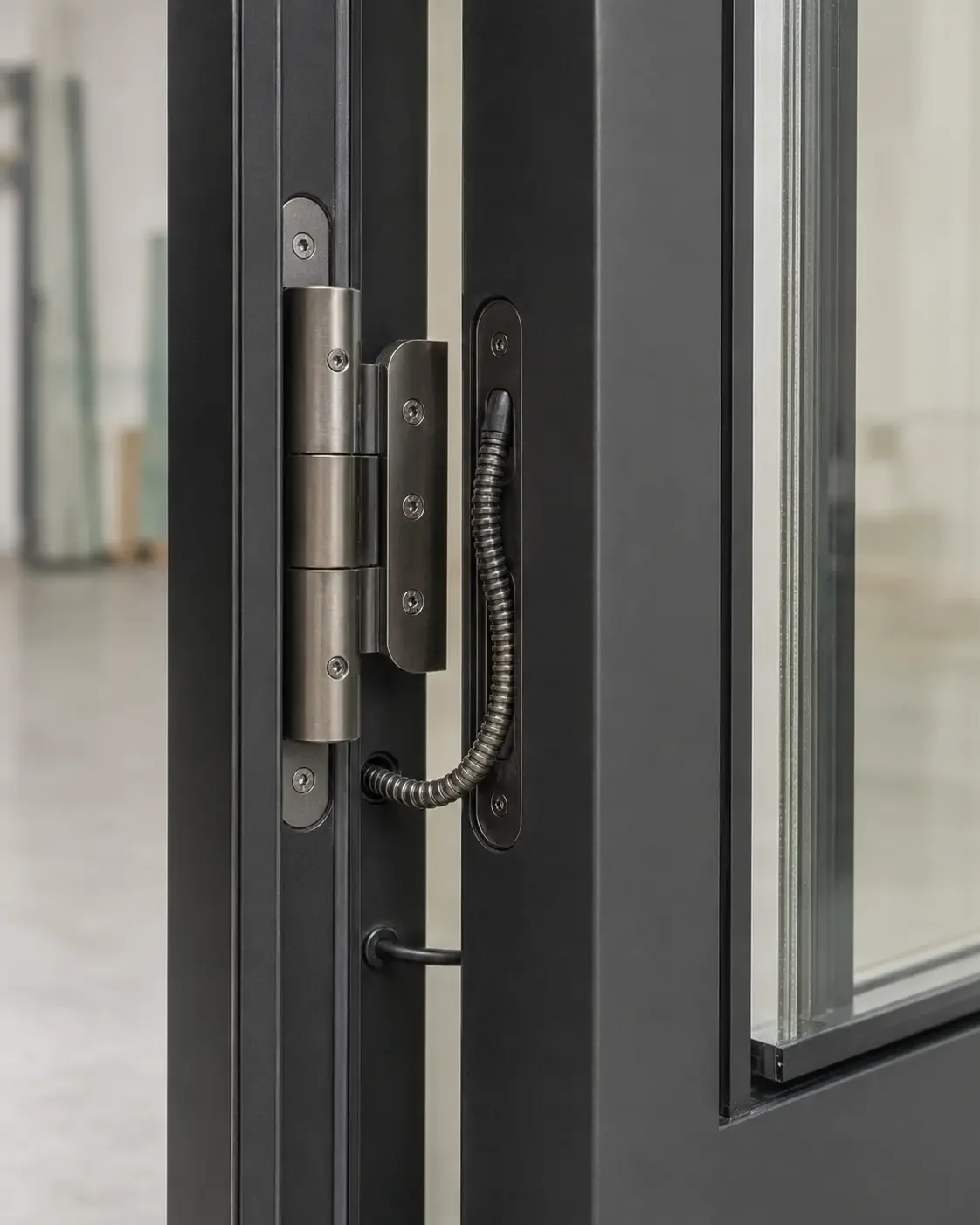
Power transfer is the central moving-door detail
Fixed sidelights and transoms can receive wiring through stationary frames. A door leaf repeatedly rotates or pivots, so the conductor path experiences movement. The transition must avoid abrasion, crushing, sharp edges, fasteners and conflicts with hinges, locks or closers. It also needs enough access for installation and future inspection.
Door fabricators may coordinate concealed loops or purpose-designed transfer hardware depending on the system. The correct method depends on the door construction and applicable electrical requirements; this article does not prescribe a universal device. What matters is that the route is intentional, protected and documented before fabrication.
Controls and desired behavior
A wall switch can be the most understandable control for a front door. Keypads, relays, access-control events or home-automation scenes may also be considered, but each adds interfaces. The controls professional should confirm signal type, electrical isolation, power requirements and what happens during network or controller failure.
Define whether the door, sidelights and transom switch together. Document the desired state after power loss and after power restoration based on the selected glass/control system. Do not describe a universal fail-safe or fail-secure behavior without testing the exact configuration. Visual privacy behavior and life-safety/security behavior are separate design topics.
Design for service without damaging the entry
Power supplies, drivers, relays and batteries should not be permanently buried behind finished surfaces without an access strategy. The installation record should identify equipment locations, panel zones, conductor routes and responsible trades. For battery concepts, record the charging or replacement procedure and who will maintain it.
Service planning also protects the aesthetic. A hidden but inaccessible component may force destructive investigation later. A small, intentionally located access point is often more professional than a completely invisible installation with no maintenance route.
Commissioning should include more than confirming that the panel changes state once. Operate the door through its full travel while the glass is switched repeatedly, inspect the transfer at hinges or pivots, confirm every control zone and record the normal operating procedure. The owner should know where the power equipment is located and whom to contact if the door operates normally but the glass does not switch. This separates a privacy-glass electrical issue from door hardware, lock or access-control service.
Decision checklist
- Is the door new enough to coordinate wiring during fabrication?
- Is building power available near the frame?
- Who is responsible for the moving-leaf power transfer?
- Where can the power supply and controls remain accessible?
- How many panels and control zones are required?
- What operating pattern and privacy state are expected?
- If battery-based, how will charging, inspection and replacement occur?
- Has the exact electrical load and component compatibility been confirmed?
- What behavior is required during a power or control failure?
For most new premium entries, answering these questions early favors a coordinated hardwired approach. A battery system should be selected because it solves a documented constraint, not because it postpones electrical planning.
Frequently asked questions
Can a smart glass door run on a battery?
A battery-based system can be evaluated, but runtime, charging, enclosure, controls and load must be engineered for the selected components. There is no universal battery kit or runtime.
Is hardwired power more reliable?
It avoids dependence on a charge cycle when building power is available, but reliability still depends on proper design, power transfer, components, installation and maintenance.
How does power reach glass in a moving door?
The door and electrical teams coordinate a protected transition between the fixed frame and moving leaf. The method depends on the door system and should be resolved before fabrication.
Can smart glass connect to home automation?
It may be possible through compatible controls or relays, but compatibility and failure behavior must be verified for the exact system by the responsible integrator.