
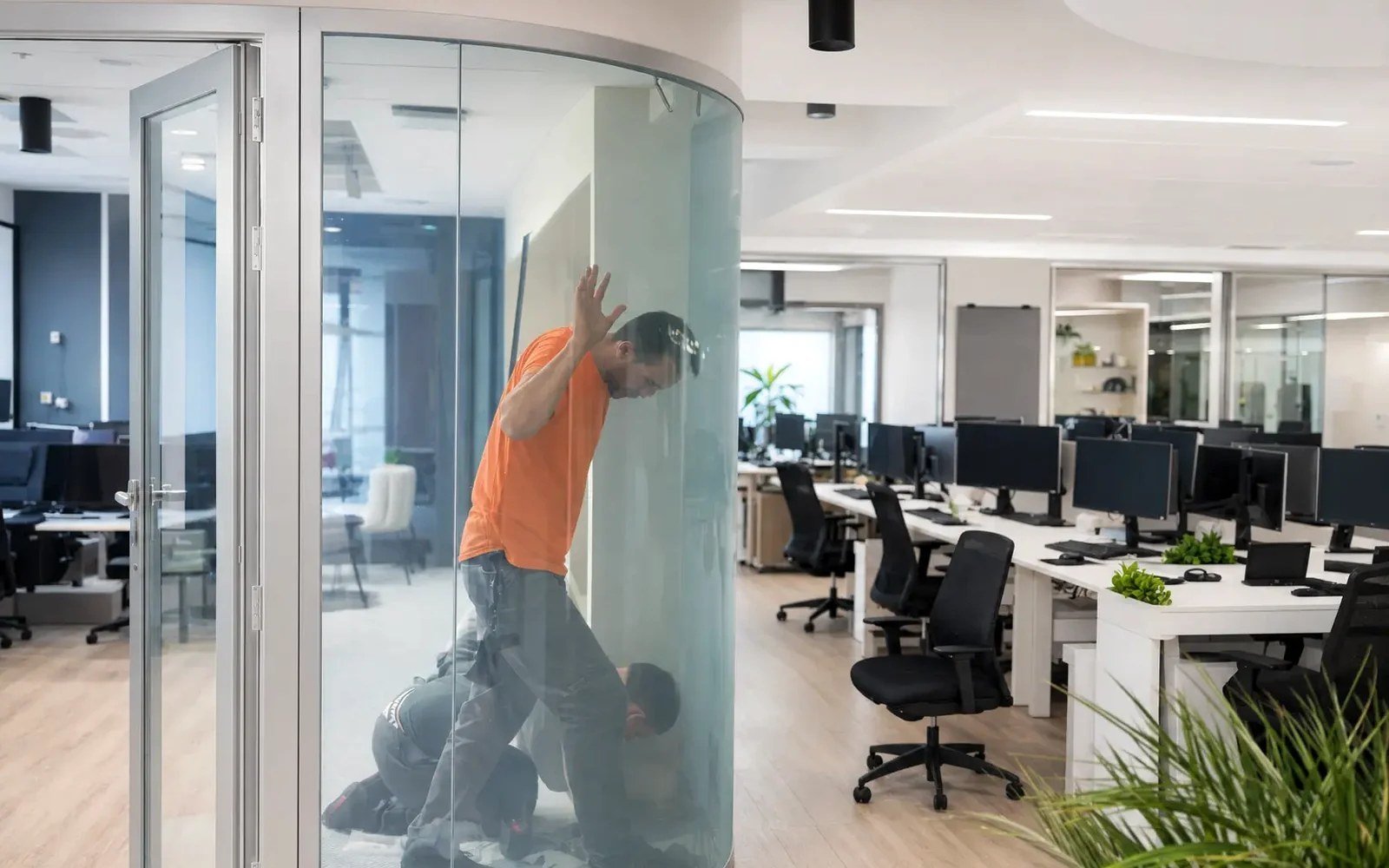
A conference room can be visually open all day and private in a second. That is the central distinction in smart glass versus roller shades: one changes the glass surface itself, while the other adds a mechanical window treatment in front of it. Both can be appropriate in commercial interiors, but they solve different project problems and require different levels of coordination.
For architects, glaziers, glass-wall dealers, and project teams, the decision should not begin with a product preference. It should begin with the opening, the privacy requirement, the desired visual language, and the execution path. A roller shade may be the practical answer for glare control at perimeter glazing. Switchable privacy glass may be the correct specification where a transparent partition must become private without changing the room's architecture.
Smart Glass Versus Roller Shades: The Functional Difference
Roller shades create privacy and light control by physically covering the opening. Their performance depends on fabric openness, color, opacity, side gaps, mounting position, and whether the shade is raised or lowered. They are familiar, broadly available, and often cost-effective across large window areas.
Switchable privacy glass uses a PDLC layer that changes from clear to frosted when power is removed or applied, depending on the specified control configuration. In its privacy state, the glass obscures direct views while continuing to admit light. It does not create a conventional blackout condition, and it should not be specified as a replacement for a dedicated solar-shading system where heat gain or screen glare is the primary concern.
That distinction matters. A conference room facing an interior corridor may need instant visual privacy, while still benefiting from borrowed daylight. Smart glass is well suited to that condition. A west-facing executive office may need to reduce afternoon glare and solar load. Roller shades, potentially paired with an appropriate glazing strategy, are usually the more direct response.
When Smart Glass Is the Stronger Specification
Smart glass earns its place when the project values immediate privacy, a clean glass-wall appearance, and control without moving parts across the opening. It is particularly effective in spaces where shades would look improvised, collect dust, obstruct circulation, or conflict with the intended architectural expression.
Typical applications include conference rooms, executive offices, healthcare consultation rooms, patient-care environments, hospitality suites, training spaces, financial offices, and premium residential bathrooms. In these settings, privacy is often intermittent rather than permanent. The room must support visibility, openness, supervision, or daylight at one moment and discretion at the next.
The value is not only aesthetic. A switchable partition can eliminate the need to lower shades before a meeting, then raise them again afterward. It avoids the uneven appearance of partially deployed shade bands across a glass-front office suite. It also gives occupants a clear, intuitive privacy control that can be tied to wall switches, remote controls, building automation, access-control sequences, or room-use logic.
For internal glass partitions, retrofit adhesive PDLC film may provide a serious execution path when suitable existing glass is already installed. The existing pane remains in place, and the film is applied to a prepared interior-facing surface. This approach can preserve a built interior while adding privacy functionality, provided the glass condition, access, edge detailing, power routing, and environmental exposure have been reviewed correctly.
For new construction, wet applications, exterior-facing conditions, and more demanding architectural assemblies, fabricated laminated smart glass is generally the appropriate path. In those projects, the PDLC layer is incorporated within the glass assembly rather than applied as an adhesive retrofit product. That distinction affects pricing, lead time, fabrication coordination, edge treatment, wiring, safety-glass requirements, and long-term durability.
When Roller Shades Make More Sense
Roller shades remain a sound specification for many projects. They are especially useful where the core requirement is solar management, glare reduction, daylight filtering, or near-blackout control. Fabric selection can be tailored to orientation, visual-transmittance targets, AV needs, and the desired level of outward view.
They also offer an economical way to address large runs of perimeter glass. A project with hundreds of feet of exterior glazing may not require electrically controlled privacy at every opening. In that case, a coordinated roller-shade package can provide effective performance without introducing electrical connections at each lite.
Shades can also be preferable where occupants want graduated control. A solar fabric may reduce glare while preserving a degree of exterior view. A dual-shade system can combine a daylighting fabric with an opaque blackout fabric. PDLC smart glass does not offer the same shading gradient. It transitions between its specified clear and privacy states, and the frosted privacy state still allows substantial light transmission.
The trade-off is architectural and operational. Shades introduce brackets, pockets, fascias, hem bars, fabric, and controls. Even well-designed systems need cleaning, alignment, occasional service, and careful coordination with sprinklers, soffits, doors, and ceiling conditions. In a glass-partition setting, they can make a refined, transparent enclosure feel more like a conventional enclosed room.
The Cost Question Needs Better Framing
Comparing first cost alone can lead to a poor specification. Roller shades typically have a lower initial cost than switchable glass or a retrofit PDLC film installation, particularly when a project is covering broad exterior openings. Smart glass involves specialized material, electrical components, controls, installation labor, and project-specific detailing.
But the relevant question is what each solution replaces. If smart glass allows a design team to maintain a clean glass partition without secondary treatments, protects a premium client experience, supports clinical discretion, or makes a high-visibility meeting room more usable, the value calculation changes. The comparison is not simply material against material. It is the cost of achieving privacy, flexibility, and architectural intent through different systems.
Project teams should also avoid treating retrofit film and fabricated smart glass as interchangeable budget lines. Retrofit PDLC film is intended for qualified existing interior glass conditions. Laminated smart glass is a fabricated assembly selected for new glass, wet areas, demanding safety applications, and environments where the performance requirement belongs within the glazing system. Misquoting one path against the other creates avoidable budget and scope confusion.
Installation and Coordination Decide the Outcome
Roller shades require coordination, but their requirements are familiar: accurate field dimensions, mounting conditions, pocket or fascia decisions, electrical provisions for motorization, and control integration where applicable. Their success largely depends on proper measurement, fabric selection, and installation discipline.
Smart glass requires a more specialized reference discipline. The team must establish whether the application is retrofit film or fabricated glass, then review glass dimensions, framing, power access, wire exit locations, control zones, switching method, and site conditions. For laminated assemblies, the glazing system, fabrication tolerances, safety requirements, and panel handling plan also matter.
Power planning deserves early attention. Switchable glass needs low-voltage electrical connection and a suitable transformer or controller strategy. The final installation should not rely on exposed wiring, late-stage improvised routing, or an assumption that electrical work can be resolved after the glazing is complete. A clean result comes from coordinating the electrical and glazing scopes before fabrication or installation begins.
For interior retrofit work, substrate condition is equally important. Film installation is not a corrective layer for damaged, contaminated, deeply scratched, or poorly accessible glass. It requires an appropriate pane, a controlled installation environment, and access that supports precise application and edge finishing. Qualified installers and glass-wall partners protect both appearance and performance by identifying these conditions early.
Privacy, Maintenance, and User Experience
Smart glass has a clear advantage where privacy must be immediate and consistently available. There is no fabric to pull, no shade to tangle, and no need to choose between an open glass-wall design and a private meeting. In the privacy state, the surface becomes a diffuse screen that can also support projection or digital content in selected applications.
That said, frosted PDLC privacy is visual obscuration, not sound isolation. A private glass conference room may prevent sightlines while still requiring acoustic glass, door seals, wall construction, and ceiling details appropriate to confidential conversation. Smart glass should be specified alongside the room's complete privacy strategy, not as a substitute for acoustic design.
Roller shades are straightforward for users, but their results can vary. A shade may leave perimeter gaps, move with air currents, or remain partially deployed after use. In hospitality, executive, healthcare, and client-facing spaces, those small operational details can affect the perceived quality of the environment.
A Combined Strategy Can Be the Right Answer
The choice is not always either-or. Perimeter glazing may benefit from roller shades for solar and glare control, while interior conference-room partitions use smart glass for on-demand privacy. This combination assigns each system to the job it performs best.
It can also preserve design consistency. A workplace may use shades discreetly at exterior windows, where performance demands are driven by daylight and solar exposure, while maintaining clear switchable partitions in the interior to keep circulation zones bright and visually open. The result is more disciplined than forcing one technology to solve every condition.
For qualified commercial projects, the right next step is to review the opening before selecting the product category. Confirm whether the glass already exists, whether the privacy need is visual or solar-related, whether the application is dry or wet, and how power and controls will be coordinated. That early clarity gives the project team a cleaner specification and a more dependable installation path.