
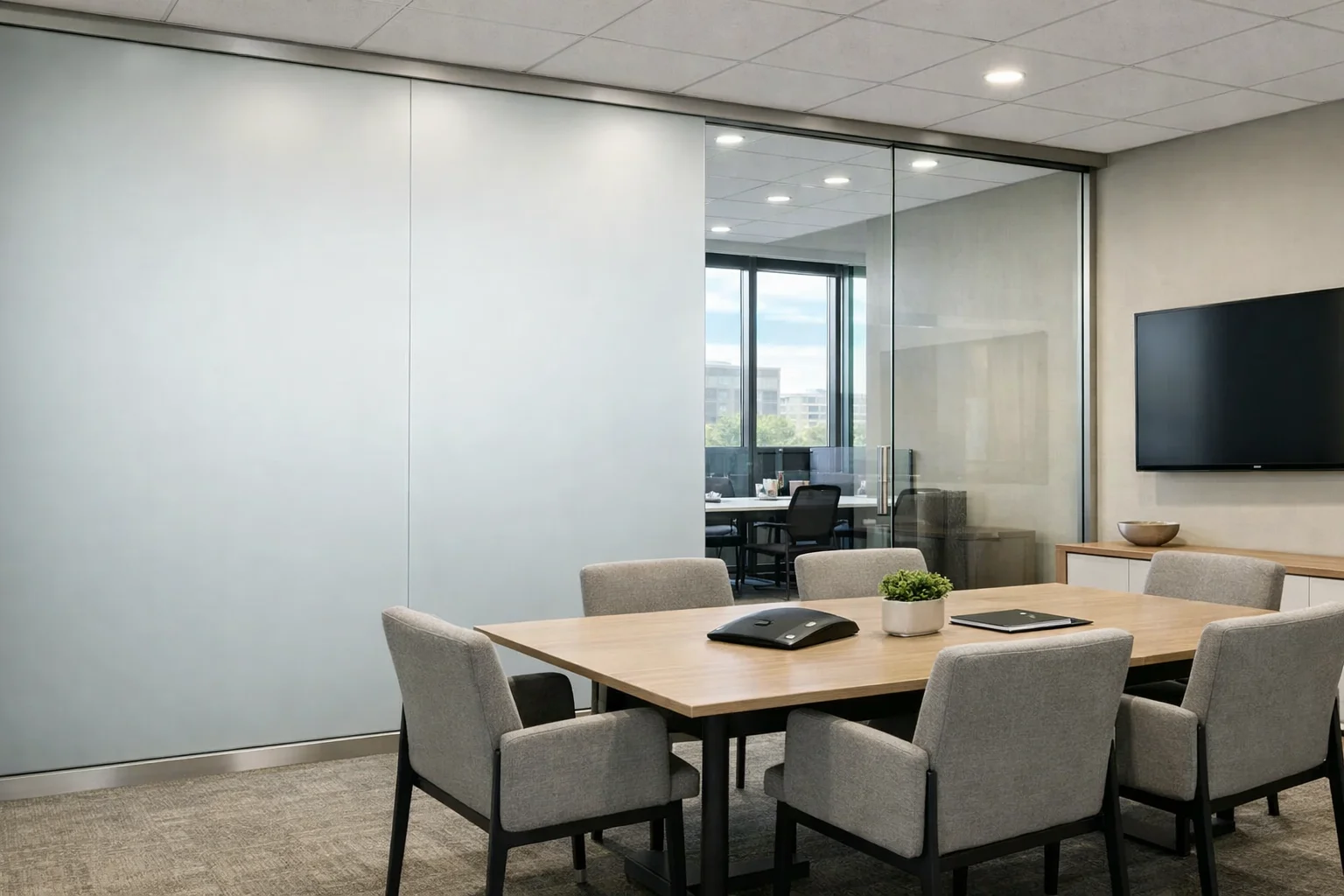
Searching for a smart film installer near me usually starts with one practical question: can an existing glass wall, door, or partition become private on demand without replacing it? In many cases, PDLC smart film can be considered for suitable existing interior glass. The right next step is not simply choosing a film—it is confirming the application, electrical plan, and installation conditions.
Start with the right solution: retrofit film or laminated smart glass
PDLC smart film, also called switchable privacy film, is a retrofit-oriented option installed on suitable existing glass. When powered, it changes between transparent and translucent, frosted-looking privacy states. It requires an electrical connection and a control method.
Laminated switchable privacy glass is different. Its PDLC layer is protected within a fabricated laminated glass assembly, making it a more integrated option for new construction, glass replacement, wet-area planning, and premium architectural projects. It also requires early coordination around fabrication, glazing, dimensions, edge details, and electrical integration.
If the glass is already installed and remains suitable, a retrofit review may be the more relevant starting point. Explore PDLC smart film for existing glass privacy for the retrofit pathway.
What a smart film installer should review before quoting
A useful installation conversation should go beyond a square-foot estimate. Suitability and pricing can be affected by the existing glass, access, wiring route, controls, dimensions, edge treatment, and site conditions.
1. The glass and application
Ask whether the proposed application is appropriate for the glass already in place. Existing office partitions, conference-room walls, interior doors, and similar interior glazing may be candidates for review. The installer should also distinguish visual privacy from other requirements: PDLC film is not blackout film, does not automatically make glass security-rated, and does not by itself provide acoustic privacy.
2. Electrical power and controls
Switchable film needs power and a control approach. Before work begins, clarify where wiring will run, how the system will be controlled, and which trade will coordinate the electrical work. Planning this early helps avoid treating wiring as an afterthought in a finished space.
3. Edges, sealing, and environment
Film edges, wiring, sealing, exposure, wet conditions, and installation quality matter. For bathrooms, shower-adjacent glazing, or other demanding environments, ask whether a fabricated laminated smart-glass assembly is the more suitable option rather than assuming retrofit film is appropriate.
4. Access and business disruption
For a small business, the practical concern is often how work will affect a meeting room, private office, reception area, or consultation space. Discuss access, work sequencing, electrical coordination, and any limitations that could affect normal use of the area during installation.
Questions to ask a switchable privacy film installer
- Is my existing glass suitable for PDLC smart film?
- What needs to be confirmed during the site review?
- Where will power, wiring, and controls be located?
- How will film edges and visible wiring be planned for this application?
- Is this a dry interior-glass retrofit, or should laminated smart glass be evaluated instead?
- What will the system provide: visual privacy, blackout, solar control, or another function?
- Which responsibilities belong to the installer, electrician, glazier, and project owner?
Clear answers help prevent a common mismatch: expecting a privacy product to solve a separate blackout, sound-control, security, or solar-control requirement. Where a project needs privacy plus another function, a hybrid system using PDLC alongside shades, curtains, or solar-control technology may be worth discussing. Each component should be evaluated for its actual role.
Why fit comes before price
A price discussion is more useful after the application is defined. Two glass walls with similar dimensions can have different planning needs because of access, existing glass condition, electrical routing, controls, edge details, and the environment around the installation.
For office glass walls, the goal is often privacy on demand while preserving an open layout when the system is transparent. See office privacy glass solutions for applications involving conference rooms, glass walls, and modern workspaces.
A practical next step for existing glass
Document the location, approximate glass dimensions, intended use, and any visible constraints around power or access. Then request a project review that identifies whether retrofit smart film is a suitable path or whether laminated switchable privacy glass should be considered instead.
Frequently asked questions
Can smart film be installed on existing glass?
PDLC smart film can often be retrofitted on suitable existing glass without replacing the glass. A site and application review is needed because glass condition, wiring, dimensions, edges, environment, and installation conditions can affect suitability.
Does switchable privacy film provide blackout?
No. PDLC smart film provides visual privacy by changing to a translucent, frosted-looking privacy state. It is not blackout film. Projects requiring true blackout may need a separate shade, curtain, or another appropriate system.
Does smart film make a glass wall soundproof?
No. Smart film provides visual privacy and does not by itself create acoustic privacy. Acoustic requirements should be evaluated separately as part of the partition or room design.
When is laminated smart glass a better choice than retrofit film?
Laminated smart glass may be the more appropriate option for new construction, glass replacement, wet-area planning, and projects seeking a more integrated architectural assembly. It requires custom fabrication and early glazing and electrical coordination.