
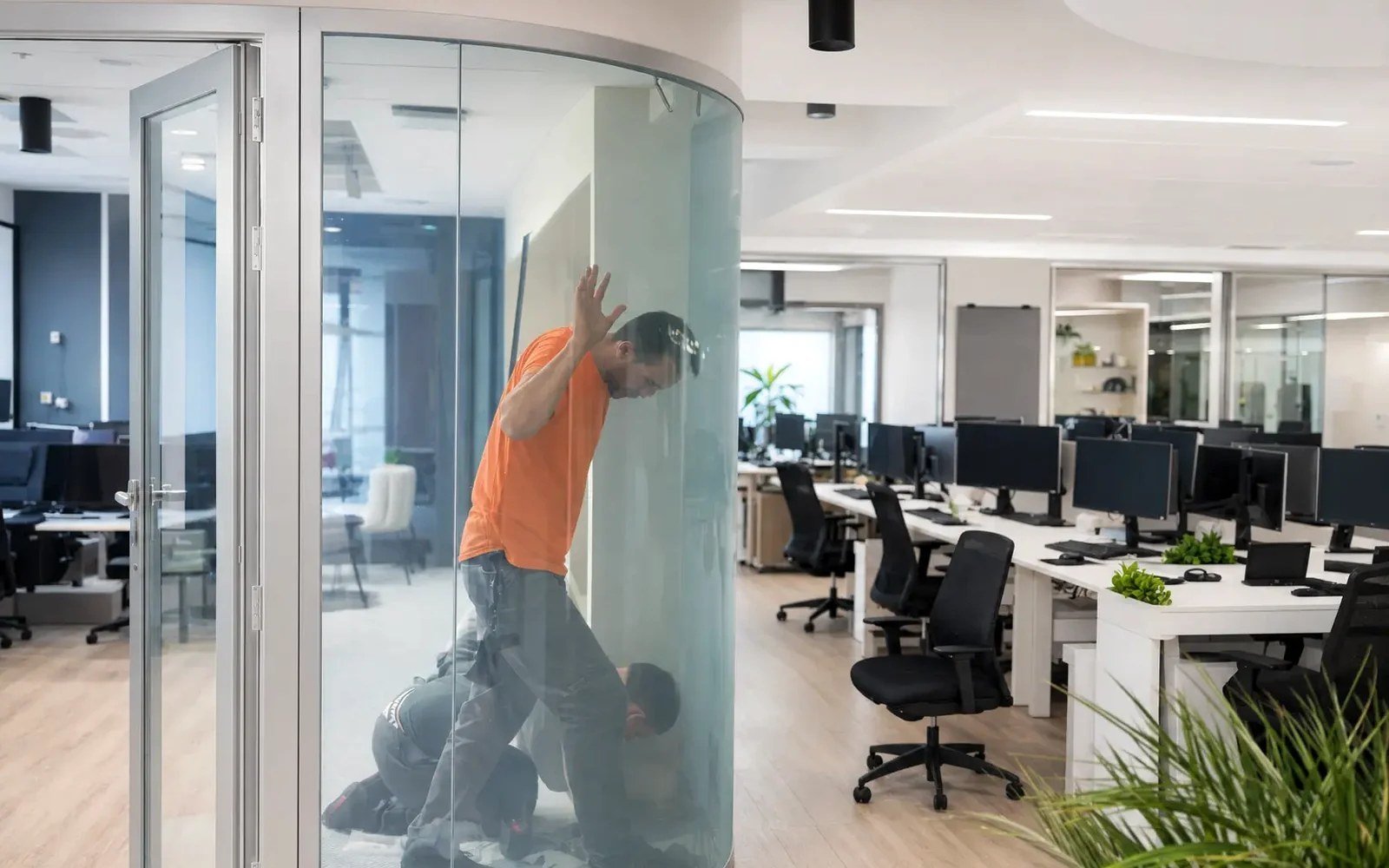
A conference-room partition can look straightforward on a reflected ceiling plan, then become a code issue when it intersects a rated corridor, smoke barrier, or fire-resistance-rated wall. That is where the question of PDLC fire rating needs to become more precise. PDLC is a switchable privacy technology, but a fire rating - if one is required - applies to a tested and listed glazing assembly in a defined opening condition. It does not automatically transfer to a privacy film, an interlayer, or a piece of glass simply because those components are used together.
For architects, glaziers, wall-system dealers, and project teams, the practical objective is not to find a generic “fire-rated PDLC” claim. It is to establish whether the exact opening, framing, glass build-up, switching layer, wiring approach, and installation condition can satisfy the authority having jurisdiction and the project’s code path.
PDLC Fire Rating Starts With the Assembly
PDLC, or polymer dispersed liquid crystal, changes the visual state of glass when power is applied. In its opaque state, it provides visual privacy. In its clear state, it permits visibility through the glass. That performance is useful in healthcare, executive interiors, meeting rooms, hospitality suites, and other environments where privacy must be controlled without shades or curtains.
Fire performance is a separate question. Fire-rated glazing is evaluated as part of a system designed for a particular use: a fire door vision panel, a sidelাইট, a borrowed-lite opening, a corridor wall, or a rated partition. The governing test and listing may address fire endurance, hose-stream performance, temperature rise, smoke and draft control, impact safety, or a combination of those requirements.
A switchable layer cannot be treated as an add-on with no consequence. If PDLC film is applied to an existing rated lite, the alteration may affect the listed condition, surface limitations, edge details, electrical routing, visibility requirements, warranty, or the approval position of the glazing manufacturer. If PDLC is laminated into a fabricated glass unit, it becomes part of the glass construction that must be evaluated within the relevant fire-rated assembly.
The disciplined question is: what has been tested, listed, and approved for this exact condition? That question protects the design intent and prevents an expensive late-stage substitution.
First Decide Whether a Rating Is Actually Required
Not every switchable glass installation needs a fire rating. Many interior conference rooms, private offices, treatment rooms, and premium residential partitions sit outside of rated wall or opening requirements. In those conditions, the core specification discussion is usually privacy performance, safety glazing, glass thickness, electrical coordination, edge concealment, and compatibility with the selected partition system.
The issue changes when switchable glass is located within or adjacent to a rated assembly. A rated corridor wall, exit enclosure, fire barrier, occupancy separation, or door opening may impose requirements that a typical interior glass partition does not.
Project teams should identify the code condition before requesting a price. A few early facts matter: the wall type and required rating, whether the glass is in a door or fixed opening, the size of the lite, the framing system, the required safety classification, and whether smoke control is involved. The architectural drawings and code analysis should establish the intended condition, while the authority having jurisdiction retains final approval.
This is not paperwork for its own sake. A visually identical panel can follow very different fabrication and approval paths depending on where it sits in the building.
Retrofit Film and Fabricated Smart Glass Are Different Paths
The distinction between existing glass and new glass is especially important for fire-rated conditions.
Retrofit PDLC Film for Existing Glass
Adhesive PDLC smart film is generally a retrofit solution for existing interior glass. It can be an effective path where the installed glazing is suitable, the glass is accessible, and the application is not governed by a fire-rated listing that would be compromised by the modification.
For ordinary non-rated interior partitions, retrofit may reduce disruption and preserve existing frames. It still requires careful field measurement, clean glass preparation, electrical planning, connection concealment, and realistic expectations around edges and visible busbar details.
For a rated lite, however, retrofit should never be assumed acceptable. The glass may carry a manufacturer listing with defined conditions of use. Adding a film to one face can create a condition outside that listing. The correct next step is to review the documented fire-rated system, consult the responsible manufacturer or listing holder as appropriate, and confirm the acceptance path with the project’s code professionals and AHJ.
Laminated Smart Glass for New Construction
When switchable privacy glass is being specified into a new partition, door system, shower enclosure, exterior-facing condition, or demanding architectural installation, fabricated laminated smart glass is usually the more controlled route. The PDLC layer is incorporated into the glass build-up during fabrication rather than added in the field.
That does not make the resulting panel fire-rated by default. It does, however, give the project team a clearer basis for engineering the glass construction, coordinating dimensions and edgework, managing safety requirements, and evaluating whether a suitable tested fire-rated configuration exists for the application.
In a rated condition, the glass composition cannot be selected independently from the frame, glazing method, seals, setting blocks, and allowable lite size. The finished assembly must follow the applicable listing and installation instructions. A fabricated smart-glass concept that looks viable in a sample review may still fail the project if it cannot be reconciled with the required fire-rated system.
What to Verify Before PDLC Enters the Specification
The cleanest specifications separate privacy requirements from fire and life-safety requirements, then bring them together only where a documented assembly supports both. Before committing to a PDLC solution in a potentially rated location, verify these project facts:
- The exact wall or opening rating, including whether the condition requires fire-protection-rated or fire-resistance-rated glazing.
- The applicable tested and listed assembly, including approved frame, glass type, lite dimensions, glazing materials, and installation orientation.
- Whether the proposed switchable glass construction is explicitly included in the approval path, rather than treated as a comparable product.
- Safety-glazing, smoke-control, impact, acoustical, and electrical requirements that may apply alongside the fire rating.
- The authority having jurisdiction’s review process and the documentation needed for permit, submittal, and field inspection.
The electrical scope deserves attention. PDLC glass needs low-voltage power, conductors, and controls. In a rated wall, penetrations and raceway paths may be restricted. Routing power through a frame, wall cavity, or head channel is not merely a coordination detail if it affects the integrity of the rated assembly. The electrical design, firestopping approach, and glazing installation sequence need to be resolved together.
Avoid the Most Common Specification Failure
The most common failure is using broad marketing language in place of assembly-specific documentation. Phrases such as “fire-resistant smart glass” or “fire-rated privacy film” can create a false sense of compliance if they do not identify the relevant test standard, rating duration, listing, approved system components, and limitations.
A second failure is allowing the rating question to appear after procurement. By that point, the wall system may be installed, the glass sizes may be fixed, and the selected PDLC product may be incompatible with the required approval path. The resulting options are usually limited: redesign the opening, relocate the privacy function, use a different wall strategy, or accept schedule and budget impact.
There are also cases where the right answer is to keep the rated opening conventional and locate switchable privacy glass in an adjacent non-rated partition. That can preserve the design objective while respecting the tested system. It is not a compromise in execution discipline. It is often the most reliable way to protect both the life-safety requirement and the user experience.
Build the Review Around Real Project Conditions
For qualified commercial projects, a productive PDLC review begins with drawings, wall details, opening schedules, project location, and the intended privacy use case. The project team should identify whether the request concerns existing glass or new fabricated glass, then flag any rated assemblies before the smart-glass build-up is quoted.
Smartglass USA approaches this as a specification and execution question, not a commodity-film transaction. The appropriate path depends on what is already installed, what the wall system permits, and what can be supported through capable fabrication and installation channels.
When privacy, code, and construction coordination are addressed at the same table, PDLC can remain a design asset rather than becoming a late-stage exception. Bring the rated-wall question forward early, document the actual assembly, and let the approved project condition determine the smart-glass solution.