
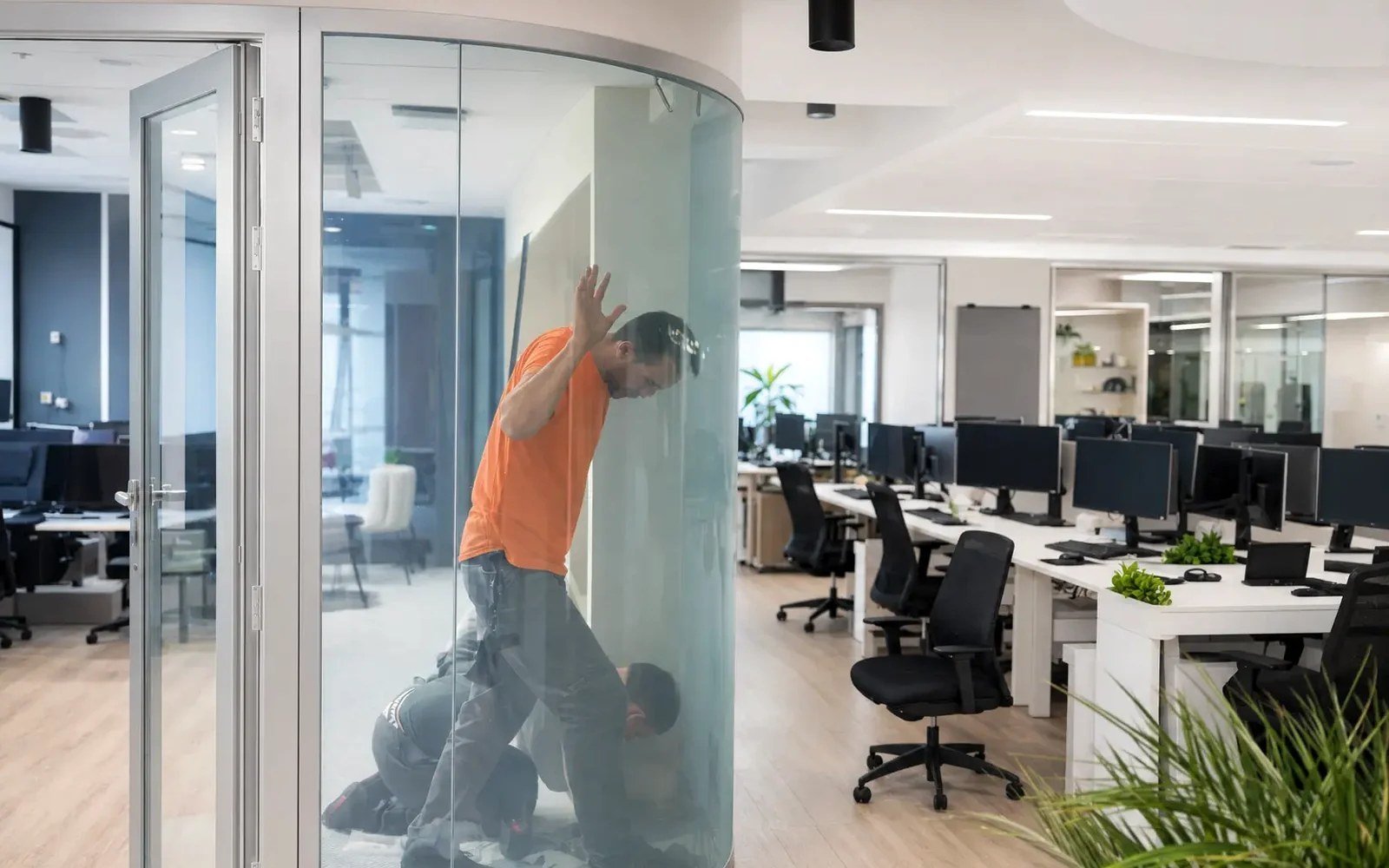
A clear sidelight beside an executive office or conference-room door can undermine the privacy the room was designed to provide. Frosted vinyl solves only one condition: permanently obscured glass. For projects that need visibility during normal circulation and privacy for meetings, HR conversations, clinical consultations, or sensitive work, the question is how to retrofit office sidelights without replacing an otherwise sound interior glazing system.
For qualifying existing interior glass, retrofit PDLC smart film can be the appropriate path. The distinction matters: adhesive film is an applied solution for existing glass, while laminated smart glass is a fabricated assembly for new glass, replacement glass, wet locations, exterior-facing conditions, and more demanding architectural requirements. Treating those paths as interchangeable is where many estimates and installations go wrong.
Start With the Existing Glass, Not the Film
Office sidelights vary more than they appear to. A narrow pane framed beside a wood door may be monolithic tempered glass in a simple stop system. A full-height sidelight in a demountable partition may be insulated, laminated, fire-rated, acoustic, or part of a proprietary wall package. The glazing type, frame detail, and access to power determine whether retrofit film is a serious execution path.
The first review should confirm the dimensions of each visible glass lite, the condition of the glass, the framing system, and which face is accessible for application. PDLC film is typically installed on the interior-facing surface of existing interior glass. Scratches, chips, failed seals, deep etched patterns, and uneven decorative glass can affect the finished appearance and may point to replacement rather than retrofit.
Door-adjacent sidelights also require a code and system check. If the existing lite is fire-rated, impact-rated, part of a labeled opening, or part of a tested partition assembly, do not assume an applied film is acceptable. The responsible design and code team should verify that the proposed work does not compromise required ratings, markings, vision-panel requirements, or manufacturer conditions. Smart glass is a privacy system, not a substitute for opening-system compliance.
How to Retrofit Office Sidelights: Define the Privacy Condition
PDLC smart film uses an electrically controlled liquid-crystal layer. When powered, it becomes clear enough to maintain an open visual connection. When power is removed, it shifts to a frosted privacy state that obscures direct views while still admitting light. It is well suited to sidelights where occupants need to change the condition rather than live with permanent opacity.
That description should not be mistaken for blackout performance. In its private state, PDLC provides visual obscurity, but it does not eliminate light transmission or prevent silhouettes when someone stands very close to the glass under strong backlighting. Conference rooms requiring presentation blackout, for example, may need an additional shading strategy. Healthcare and HR settings may also need the project team to assess sightlines from corridors, reception desks, and adjacent rooms rather than relying on a sample viewed in isolation.
The desired control behavior should be established before pricing. Most office sidelight projects use one of three approaches: a local wall switch, a low-voltage control integrated near the door, or a coordinated room control scene. A local switch is direct and cost-conscious. Room controls are appropriate when sidelights, borrowed-light panels, and larger glass partitions must change together. The correct choice depends on user behavior, electrical access, and who will own the controls after turnover.
Survey Electrical Access Before Finalizing the Layout
A PDLC retrofit is not merely a glazing application. It is a low-voltage electrical installation with visible architectural consequences if the routing is left until the end. Each film panel requires a busbar connection and lead wire. Those leads must reach the specified transformer or controller through a planned, protected route.
For sidelights, the cleanest route is often concealed within the frame, head condition, adjacent wall cavity, or a coordinated door-frame detail. Some existing systems offer enough frame depth to hide conductors. Others require a small, carefully considered surface raceway or a nearby accessible route. A proposal that identifies only the glass dimensions but not the power path is incomplete.
During field verification, document the location of the electrical source, the route to each sidelight, transformer placement, access for service, and the division of work between electrician, glazier, wall-system installer, and controls contractor. Transformers should remain accessible rather than buried behind finishes with no practical service path. On larger groups of sidelights, circuit loading and zoning should be reviewed as part of the control design, not improvised panel by panel.
Electrical behavior also affects the user experience. PDLC film generally defaults to its frosted state when power is off. That can support a privacy-forward condition during a power interruption, but it should be discussed with the owner. A facility that expects glass to remain clear during every outage may require a different operational conversation and, where appropriate, backup-power coordination.
Prepare the Glass for a Controlled Installation
The visible quality of retrofit film is determined long before the final edge trim is applied. The glass must be thoroughly cleaned, free of silicone residue and construction dust, and measured against the actual exposed opening rather than a nominal schedule. Film panels should be fabricated to the verified layout, including the intended busbar orientation and lead exit location.
The installer should sequence work after nearby high-dust trades are substantially complete. Drywall sanding, ceiling drilling, paint overspray, and active flooring work create contamination risks that are difficult to correct once film is applied. This is especially relevant in occupied renovations, where access windows may be short and corridor traffic remains active.
A clean installation also depends on edge discipline. The film should not be treated as a loose decorative overlay. Its perimeter, wire exits, and any protective edge treatment must be coordinated with the frame and sightline. Poorly planned leads, exposed adhesive transitions, or inconsistent edge setbacks can make a premium glass partition look improvised. Narrow sidelights are particularly unforgiving because the edge condition represents a larger share of the visible field.
Coordinate the Door, Partition, and User Experience
Sidelights are often part of a larger privacy sequence. An executive office may have a glass door, a sidelight, and a borrowed-light transom. A clinic consult room may require corridor-facing glazing to change state as one zone. Retrofitting only one lite can be the right budget decision, but it should be intentional. If adjacent clear glass still exposes the room, the project has not solved the underlying privacy condition.
Door hardware and circulation deserve equal attention. Place switches where staff can reach them without interrupting a meeting or creating confusion for visitors. In shared meeting rooms, a control inside the room may be preferable to a corridor-facing switch. In clinical or secure environments, controls may need to be restricted, centralized, or tied to room-use protocols.
For paired or repeated office modules, establish reference discipline early. Confirm one representative opening, wire route, edge condition, and control location before releasing a full floor of panels. This reduces variation across field conditions and gives the installation team a repeatable standard. It also protects the owner from discovering late that each room has been solved differently.
Know When Retrofit Is Not the Right Specification
Retrofit adhesive PDLC film is a strong option for existing, qualified interior glass, but it is not the universal answer. Replacement laminated smart glass is generally the more appropriate specification when the project involves new partitions, shower enclosures, exterior exposure, insulated glazing, high-abuse conditions, or a requirement to integrate the switchable layer within a fabricated safety-glass assembly.
The same applies when an existing sidelight is damaged, poorly framed, incompatible with the desired wire concealment, or already due for replacement as part of a renovation. Trying to force retrofit onto unsuitable glass may reduce initial scope on paper while increasing field risk, visual compromise, and service complexity. The better commercial decision is often to separate what can remain from what should be fabricated new.
A qualified project review should produce more than a film quantity. It should establish the existing-glass condition, privacy objective, electrical route, control logic, installer responsibilities, finish expectations, and any code or system constraints. Smartglass USA approaches these details as part of project coordination because the value of switchable privacy glass depends on how it performs after the room is occupied, not simply on how it looks at installation.
When the glass, wiring, controls, and framing are treated as one coordinated scope, an office sidelight can move from a permanent exposure point to a controlled architectural privacy surface. That is the standard worth carrying into the field.