
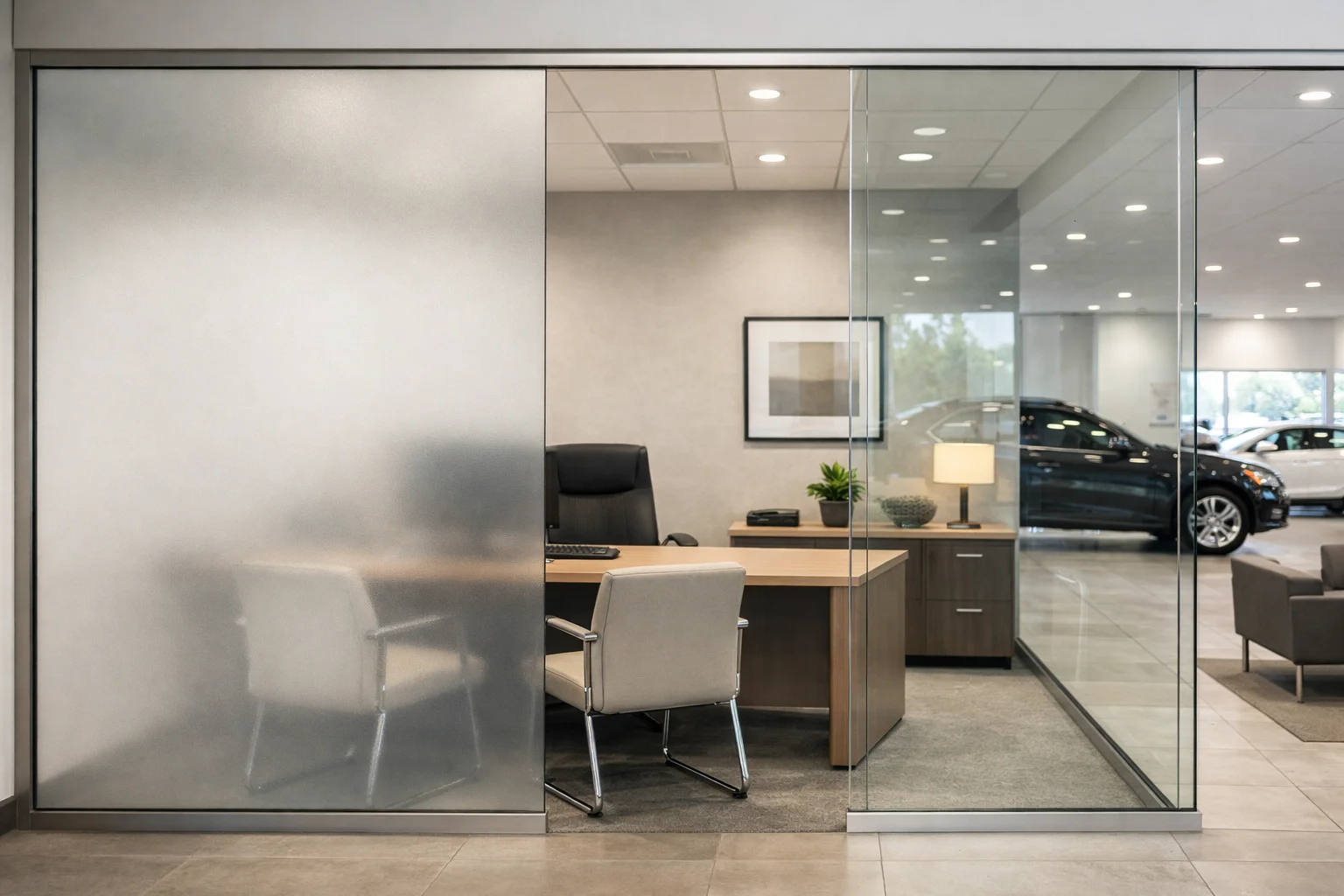
New car dealership projects often use interior glass to make sales, delivery, and consultation areas feel open. Finance offices, however, may need visual separation when sensitive conversations take place. Laminated switchable privacy glass can help design teams create a glass partition that changes between a transparent state and a translucent, frosted-looking privacy state when connected to power and controls.
Why finance-office privacy needs a defined brief
A dealership finance office can need a different level of visual separation than a sales desk or customer lounge. Before selecting a glass treatment, the project team should define when occupants need views through the partition and when those views should be obscured.
Switchable privacy glass is designed for adjustable visual privacy. In its transparent state, it can maintain the visual openness of a glass wall. In its privacy state, it changes to a translucent, frosted-looking appearance. That can suit a finance office intended to remain visually connected to the showroom at some times but requiring discretion during selected conversations.
It is important to separate that goal from other requirements. Switchable privacy glass is not blackout glass, does not by itself provide acoustic privacy, and does not automatically make a partition security-rated. If the room needs sound control, blackout, solar control, or a particular security performance, those needs should be addressed separately in the project brief.
Why laminated smart glass fits a new dealership scope
Laminated smart glass is a fabricated assembly in which the PDLC layer is protected within the laminated glass. This makes it a different product path from retrofit PDLC smart film, which is applied to suitable existing glass.
For a dealership under construction, undergoing planned glass replacement, or receiving new interior partitions, a laminated assembly may be worth evaluating because the glass, framing, edge details, electrical routing, and controls can be considered together. The result is an integrated architectural approach rather than a late treatment added after the partition has been completed.
That does not mean every interior glass wall requires laminated smart glass. It means the product is most relevant when the project already has a new-glazing decision to make. For application context, see smart glass for car dealership finance offices and showrooms.
Five coordination decisions to make before fabrication
1. Identify the privacy zones on the plan
Mark the rooms and sightlines where adjustable visual privacy is actually needed. A finance office may be the priority, while adjacent sales offices, manager rooms, delivery areas, or customer spaces may have different requirements. This prevents the team from treating switchable glass as a default finish for every pane.
2. Coordinate glass dimensions, framing, and edge details
Laminated smart glass requires custom fabrication. Final dimensions, framing interfaces, edge conditions, and glass details need review before the glass is ordered. The design team should avoid assuming that a standard interior glass detail can be converted to switchable glass without confirming the specific assembly.
3. Bring electrical routing into the partition discussion
Switchable glass requires an electrical connection and a control method. Electrical routing, transformers, controls, and the relationship between wiring and the glass system should be addressed with the relevant trades before installation. Early coordination is especially useful when the design intent calls for a clean interior-glass appearance without unplanned visible wiring.
4. Define how users will operate the privacy state
A finance-office team needs a practical way to use the glass. The project brief should identify the intended control approach and who will operate it. The team should also discuss the desired operating state during a power interruption, particularly where visual discretion is important to the room’s use.
5. Review cleaning, exposure, and site conditions
Installation and site conditions remain relevant after product selection. Cleaning practices, exposure, sealing requirements, surrounding finishes, and construction sequencing should be reviewed for the specific location. These factors can affect suitability and should not be left to a generic glass-partition assumption.
Visual privacy is not the same as complete room privacy
“Privacy” can mean different things to different stakeholders. A customer may expect an obscured view through the glass, while an operations team may also expect quieter conversations, reduced glare, or complete darkness. Those are not interchangeable outcomes.
- Visual privacy: switchable glass can change visibility through a glass partition on demand.
- Acoustic privacy: the room needs a separate acoustic strategy if conversations must be less audible.
- Blackout: a shade, curtain, or another dedicated solution may be needed where full light blocking is required.
- Security: security performance must be specified and supported independently; switchable functionality alone does not establish a security rating.
Defining each function clearly helps the architect, dealer principal, interior designer, glazier, electrical contractor, and owner make decisions based on the actual requirement rather than a broad label.
When a different product path may be appropriate
If existing glass partitions will remain in place, a retrofit PDLC smart film solution may be the product path to evaluate instead. Retrofit film can often be applied to suitable existing glass without replacing that glass, but suitability depends on the condition of the glass, dimensions, edges, wiring, installation, and site conditions.
If the dealership project needs visual privacy plus blackout or solar control, a hybrid privacy system may be worth discussing. In that approach, PDLC provides visual privacy while shades, curtains, or solar-control technology address their separate functions. Each element should be selected for the performance it is intended to provide.
For broader product context, review switchable privacy glass for premium architectural spaces.
Bring the right information to the project review
A productive early review can include partition plans, preliminary glass locations, intended room use, control preferences, relevant electrical constraints, and the planned construction sequence. These inputs help determine whether laminated switchable privacy glass is appropriate for the finance-office scope and what coordination will be needed before fabrication.
Request a smart glass project review for a new dealership project.
Frequently asked questions
What does switchable privacy glass do in a dealership finance office?
It provides adjustable visual privacy by changing between a transparent state and a translucent, frosted-looking privacy state when connected to power and controls. It can help a glass-walled finance office remain visually open at selected times and obscure views at others.
Is laminated smart glass better than retrofit smart film for a new dealership?
Laminated smart glass is generally the product path to evaluate for new construction or planned glass replacement because it is fabricated as an integrated laminated assembly. Retrofit PDLC smart film may be considered when suitable existing glass is being retained.
Does switchable privacy glass make a finance office soundproof?
No. Switchable privacy glass addresses visual privacy. Acoustic privacy requires a separate room and partition strategy.
What should be coordinated before switchable glass is fabricated?
The project team should review dimensions, edge details, framing, electrical routing, transformers, controls, installation sequence, cleaning conditions, sealing needs, and the intended use of the space.