


The Opportunity Beyond Traditional Window Treatments
A window treatment company does not need to abandon blinds, shades or curtains to enter the smart privacy category. The opportunity begins where traditional products become visually heavy, mechanically awkward or difficult to integrate with interior glass architecture.
Modern conference rooms, executive offices and glass partitions are often designed to stay visually open. The client wants daylight, clean lines and transparency—until a private meeting begins. A blind can cover the glass, but it also introduces slats, fabric, headrails, motors, cords or pockets into a space whose architectural value came from looking simple.
That gap appears in glass conference rooms, frameless doors, executive suites, medical and dental consultation spaces, hotels, spas, premium bathrooms, home offices and interior partitions. These projects are already adjacent to the clients served by custom window treatment and commercial blinds companies. SmartVinyl adds another answer when the privacy requirement is instant, selective and design-sensitive.
Commercial interiors
Conference rooms, offices and glass walls where privacy must appear without permanently closing the space.
Healthcare and hospitality
Consultation rooms, spa areas and guest-facing interiors that need a clean, controllable privacy layer.
Premium residential
Bathrooms, glass doors and home offices where the owner values architectural integration more than a low-cost covering.
Existing client databases
A new reason to contact designers, contractors, property managers and homeowners who already trust the window treatment company.
What SmartVinyl Is—and What It Is Not
SmartVinyl is the retrofit PDLC smart film route from SmartGlass USA. It is applied to suitable existing glass and changes between a clearer operating state and a translucent privacy state through electrical control. It requires a transformer, a planned wiring route and a properly coordinated installation.
SmartVinyl is not ordinary window tint. Tint changes light transmission or appearance but does not switch between open and private states. It is not fixed frosted film, which stays permanently translucent. It is also not blackout film: privacy mode diffuses light and blocks direct views, but it does not make a room dark.
The clear state is not identical to untreated architectural glass. PDLC technology has characteristic haze, and that expectation should be discussed before the sale. A serious proposal also considers panel dimensions, glass condition, edge protection, access, control preferences and future serviceability.
SmartVinyl vs. Smartglass
The distinction is straightforward. SmartVinyl is installed on suitable existing glass, making it the practical retrofit route for existing conference rooms, office fronts, partitions and doors. Smartglass is switchable laminated glass manufactured with the PDLC layer integrated inside the glass assembly.
Smartglass is typically selected for new construction, replacement glass, fabricated panels, wet areas and premium architectural projects where early coordination and a more integrated finished assembly justify the higher initial investment. It requires final fabrication dimensions and closer coordination with the glass package.
A window treatment company can participate in either opportunity without pretending both products are interchangeable. The commercial value comes from identifying the correct path and bringing SmartGlass USA into the project early enough to review it.
Smart Film vs. Blinds, Shades and Curtains
No single system wins every category. The correct recommendation depends on whether the client primarily needs visual privacy, blackout, solar control, glare reduction, gradual view adjustment or architectural integration.
| Project factor | SmartVinyl | Smartglass | Blinds, shades and curtains |
|---|---|---|---|
| Existing-glass retrofit | Primary use when suitable glass already exists. | Usually requires glass replacement. | Often practical on windows and framed openings. |
| New construction | Possible, but not always the most integrated route. | Strong fit when specified and fabricated early. | Strong fit when pockets, tracks or mounting are planned. |
| Instant privacy | Yes, through electrical switching. | Yes, through electrical switching. | Fast with motorization; manual systems depend on operation. |
| Blackout capability | No. | No. | Available with appropriate blackout products and detailing. |
| Solar and glare control | Not its primary function. | Not its primary function. | Often the stronger solution for exposed exterior windows. |
| Visual integration | Clean retrofit appearance on suitable glass. | Highest architectural integration. | Can be decorative or intentionally visible; adds hardware or textile. |
| Automation | Switch, remote or compatible control strategy. | Switch, remote or compatible control strategy. | Broad motorization and smart-control options. |
| Cleaning and maintenance | Smooth surface; requires approved care and electrical service access. | Glass-cleaning routine plus control-system service. | Textiles, slats, tracks and motors may require cleaning or repair. |
| Moving parts | No moving privacy mechanism. | No moving privacy mechanism. | Commonly includes rollers, slats, tracks, cords or motors. |
| Electrical requirements | Required. | Required. | Not required for manual products; required for motorization. |
| Typical applications | Existing interior glass offices, doors and partitions. | New panels, premium interiors and fabricated glass projects. | Exterior windows, bedrooms, glare control, décor and blackout. |
| Initial investment | Premium retrofit investment. | Usually the highest initial investment. | Wide range from basic to premium automated systems. |
| Best use case | Privacy on demand on suitable existing glass. | Architecturally integrated privacy in new or replacement glass. | Blackout, solar control, glare management and adjustable exterior views. |
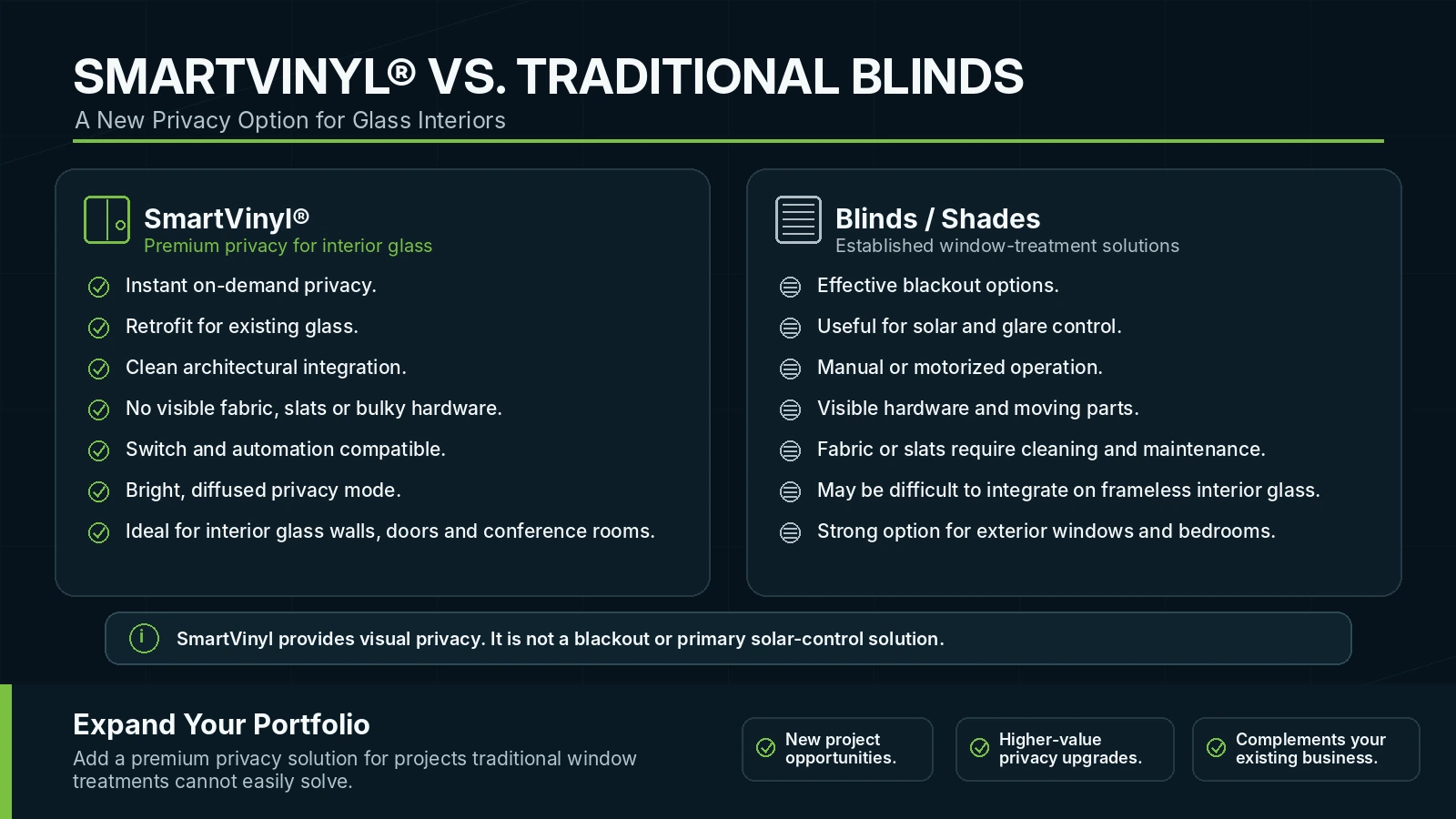
Where SmartVinyl Creates a New Sale
The strongest opportunity is not replacing a blind that already solves the client’s problem. It is recovering a project the window treatment company could not solve cleanly before.
Interior glass partitions and frameless doors may not offer a natural place for a roller, cassette or track. Conference rooms may need full visual openness most of the day and immediate privacy for a sensitive meeting. Clinics may want a smooth, easy-to-clean interior surface instead of fabric. Premium bathrooms may need privacy without making the glass permanently frosted.
In those cases, the sales conversation changes from “Which shade fabric?” to “How should this glass behave?” That opens contact with glass contractors, architects, designers, office furniture dealers, automation integrators and electrical contractors. It also helps a window treatment company enter more complex commercial and architectural projects without giving up its existing product categories.
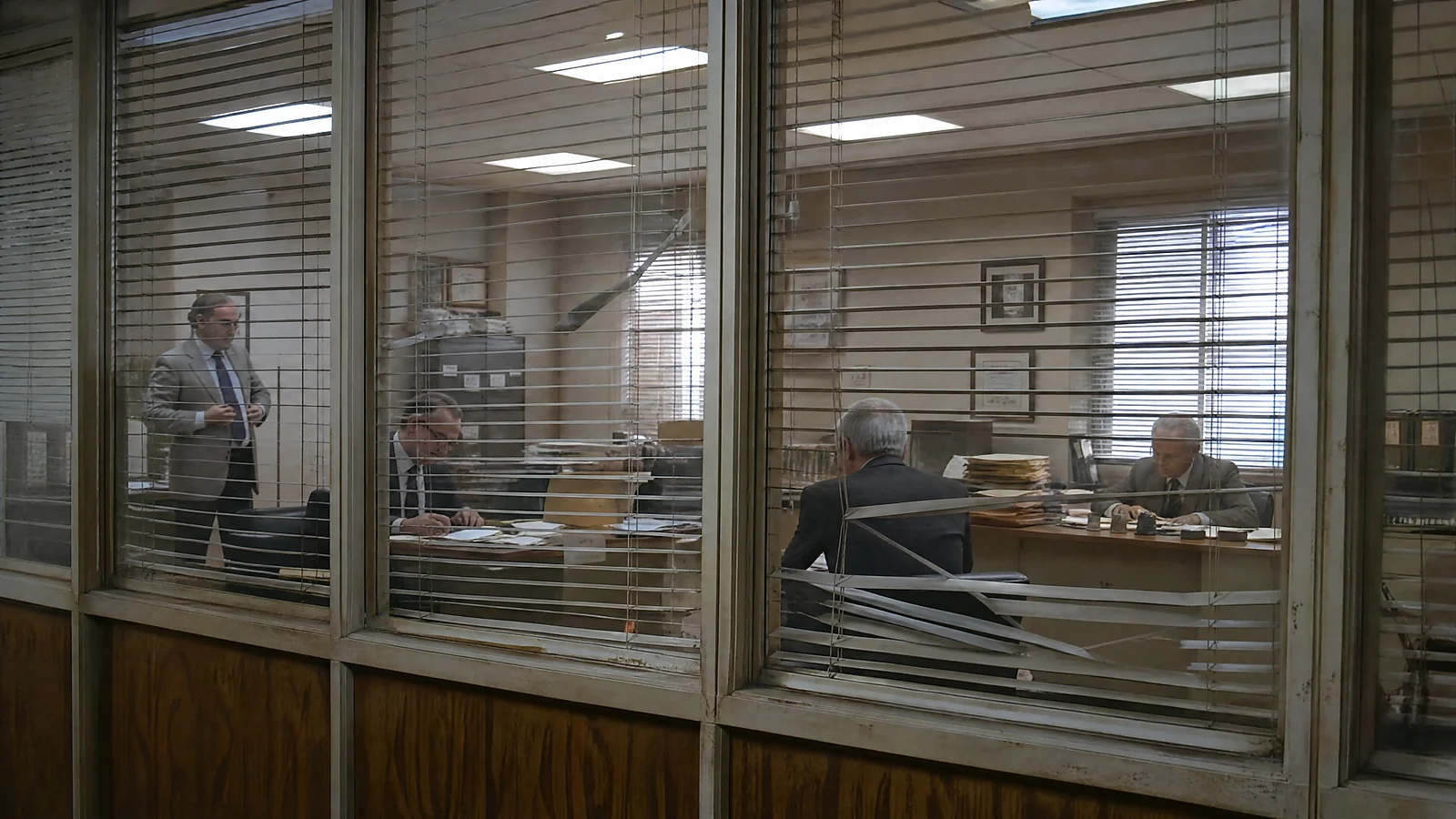
Where Traditional Window Treatments Remain the Right Choice
Blinds, shades and curtains remain the better answer when the primary goal is:
- True blackout or bedroom darkness.
- Strong solar-heat and glare management.
- Gradual control of exterior views.
- Highly exposed façade treatment.
- Decorative softness, texture or acoustic contribution.
A hybrid project can also combine PDLC privacy on interior glass with solar shades or blackout treatments on exterior windows. The two systems do not need to compete.
A Complementary Product, Not Cannibalization
SmartVinyl should not be presented as a reason to stop selling blinds or shades. It expands the catalog into a category those products do not always address well: instant privacy for interior architectural glass.
That means a company can protect its core revenue while adding a premium option, increasing average project value and reopening conversations with existing clients. A commercial blinds contractor may continue specifying solar shades for perimeter windows while adding SmartVinyl to the conference room. A residential specialist may sell blackout shades in the bedroom and a smart privacy solution in a glass bathroom.
This is also a channel opportunity. SmartGlass USA’s Partner Program can support referral, reseller and technical collaboration models. The window treatment company can remain the trusted client relationship while installation and technical responsibilities are assigned clearly.
Common Questions and Commercial Objections
“It costs more than a conventional blind.”
Often, yes. SmartVinyl is a premium electrically controlled privacy system, not a commodity covering. It should be proposed where the client values instant privacy, clean architecture and the ability to keep the glass visually open.
“Who handles electricity?”
The electrical route, transformer location and control method must be planned. The responsible licensed electrical professional and the scope of each trade should be defined before installation.
“Will the clear state look exactly like ordinary glass?”
No. PDLC has visible haze. Samples, demonstrations and realistic expectations are part of a responsible sales process.
“Who measures, installs and warranties it?”
The answer depends on the collaboration model. Final measurement, installation, electrical coordination, warranty responsibility and after-sales support should be documented project by project—not assumed.
“What happens if power fails?”
The state during a loss of power depends on the selected configuration and operating logic. There is no universal fail-safe condition that should be promised without defining the system during project planning.
“How long does it take?”
Lead time depends on technical review, final dimensions, material route, controls, installation access and project location. A date should only be confirmed after those factors are approved.
How a Window Treatment Company Can Add SmartVinyl
The process can remain commercially simple even when the technical execution requires coordination.
Detect the opportunity
Look for interior glass where the client needs selective privacy and dislikes a permanent or visually heavy covering.
Identify the glass
Confirm whether the glass exists, where it is located and what the client expects from clear and private modes.
Send preliminary information
Provide photos, approximate dimensions, city/state, framing details, access and timeline.
Receive technical guidance
Review whether SmartVinyl, laminated Smartglass or a traditional/hybrid treatment is the correct path.
Prepare the proposal
Define commercial scope, controls, electrical responsibility and the selected collaboration model.
Coordinate final measurement
Assign the qualified party responsible for verified dimensions, installation planning and site readiness.
Document delivery
Provide approved operating guidance, maintenance information, warranty scope and service contacts.
Professional Information
Add Smart Privacy to Your Portfolio
Share the type of clients you serve or send details of a current glass privacy opportunity. SmartGlass USA can review the product path, collaboration model and technical next step.