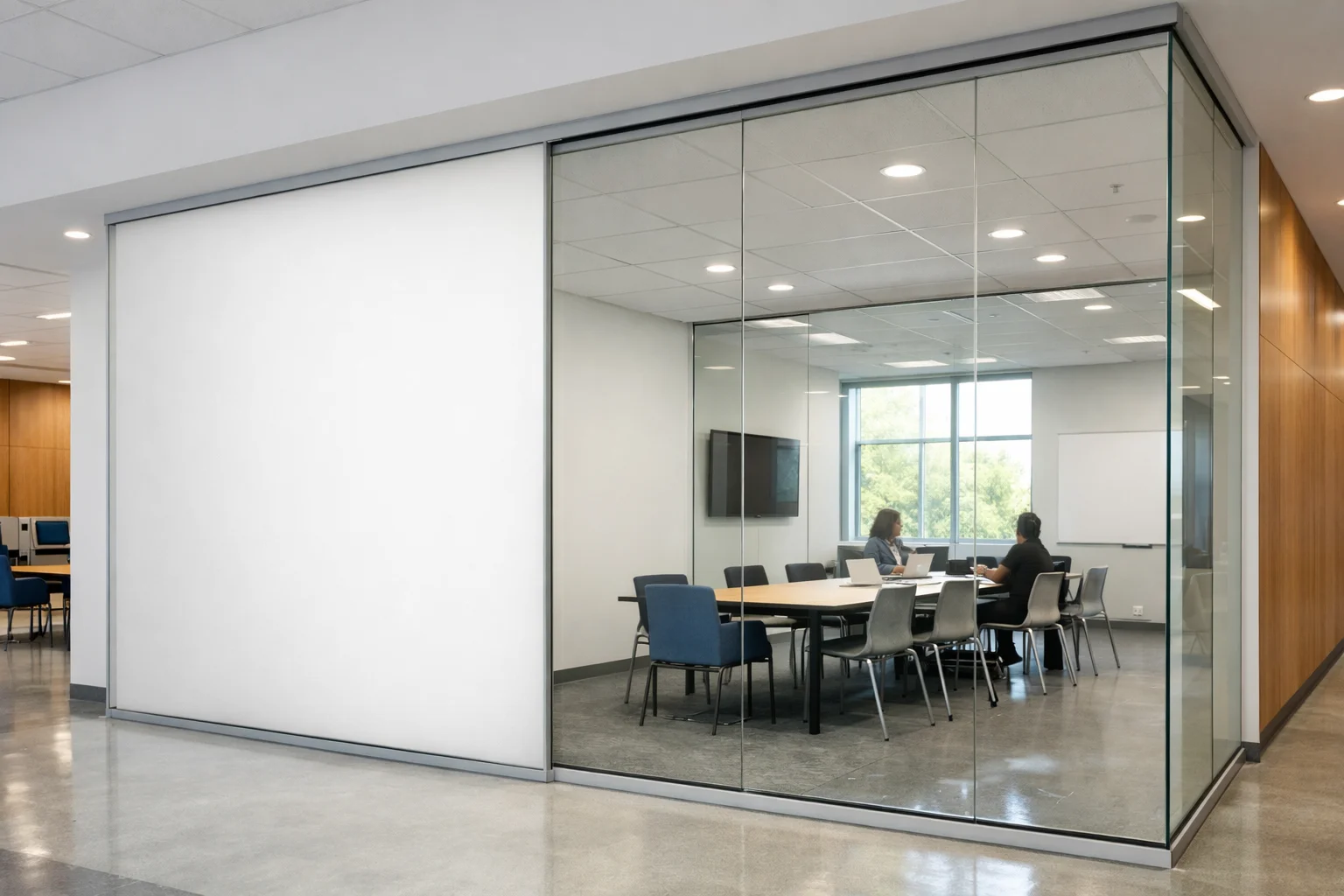
Glass partitions, sidelites, doors, and meeting-room walls can help schools create open, light-filled interiors. They can also create a practical challenge: people need visual privacy at certain moments, while some rooms need darkness for presentations or audiovisual use. Those are different requirements, and they should not be solved with the same assumption.
Start with the actual privacy problem
Before choosing a treatment for classroom or administrative glass, identify what the space must do. A counseling room, conference room, health office, or flexible meeting space may need on-demand visual privacy. A room used for projection may need reduced light or true blackout. A space with confidential conversations may also need an acoustic strategy, because visual privacy alone does not create acoustic privacy.
This distinction helps facility teams avoid specifying a product for a function it is not designed to provide.
Where PDLC smart film can fit in education spaces
PDLC smart film, also called switchable privacy film, can change between transparent and translucent, frosted-looking privacy states. On suitable existing glass, it can often be installed as a retrofit without replacing the glass. That can make it relevant for glass partitions, interior doors, administrative areas, and meeting spaces where staff need visual privacy on demand.
For an existing-glass scope, PDLC smart film for existing glass privacy may be the appropriate starting point. The project still needs review of the glass condition, wiring path, controls, edges, dimensions, sealing, installation quality, and site conditions.
Examples of questions worth asking
- Is the need visual privacy, light reduction, or true blackout?
- Is the glass already installed and suitable for a retrofit?
- Where will electrical connection, controls, and related components be located?
- Will the space be exposed to conditions that require particular attention to edges, wiring, or sealing?
- Does the room also require speech privacy or a separate acoustic solution?
PDLC privacy is not blackout
PDLC is a visual-privacy solution. It is not blackout film, and it should not be presented as a complete answer for rooms that must become dark for projection, media viewing, or other light-sensitive activities.
When a school needs both switchable privacy and a separate blackout or solar-control function, a hybrid privacy system may be more appropriate. PDLC can be combined with shades, curtains, or solar-control technology, with each component assigned to its actual job. This approach adds coordination, complexity, and cost, but it avoids asking one system to solve unrelated requirements.
Retrofit film or laminated smart glass?
The construction path matters. PDLC smart film is generally the retrofit option for suitable existing glass. It requires electrical connection and control, and installation details are important.
For new construction, glass replacement, wet areas, or a more integrated architectural finish, laminated switchable privacy glass may be considered. In that approach, PDLC is protected within a fabricated laminated assembly. It requires custom fabrication and earlier glazing and electrical coordination, and it can have a higher capital cost than many retrofit applications.
For education projects, the best choice should follow the project phase, the condition of the existing glass, the required function, and the coordination available among the facility team, designer, glazier, and electrical trade.
A practical decision path for facility teams
- List each space where glass creates a visual-privacy issue.
- Separate privacy needs from blackout, glare, solar-control, and acoustic needs.
- Identify whether the scope is a retrofit or new construction.
- Review electrical, control, edge, sealing, and installation requirements before final selection.
- Use a hybrid approach when the project needs privacy plus a separate light-control function.
For applications across schools, universities, and flexible learning spaces, explore smart glass for education and flexible learning spaces.
Plan the solution around the room, not the product label
Switchable privacy systems can help make interior glass more flexible, but the right result begins with a precise definition of the problem. If the goal is on-demand visual privacy, PDLC may be a fit. If the goal is darkness, solar management, or acoustic separation, the project may require another component or a combined system.
Request a smart glass project review to discuss the glass condition, intended use, electrical coordination, and whether a retrofit, laminated assembly, or hybrid approach should be evaluated.
Frequently asked questions
Can PDLC film make classroom glass private?
PDLC smart film can provide on-demand visual privacy by changing between transparent and translucent, frosted-looking privacy states. Suitability depends on the existing glass, electrical connection, controls, installation details, and site conditions.
Does switchable privacy film create blackout?
No. PDLC is not blackout film. Projects that need true blackout should evaluate a separate blackout solution, potentially as part of a hybrid privacy system.
Can PDLC film be installed on existing school glass?
It can often be retrofitted on suitable existing glass without replacing the glass. A project review is needed to assess glass condition, wiring, edges, sealing, dimensions, and installation requirements.
Does privacy glass provide acoustic privacy?
No. PDLC provides visual privacy and does not necessarily provide acoustic privacy. Acoustic requirements should be addressed separately.