
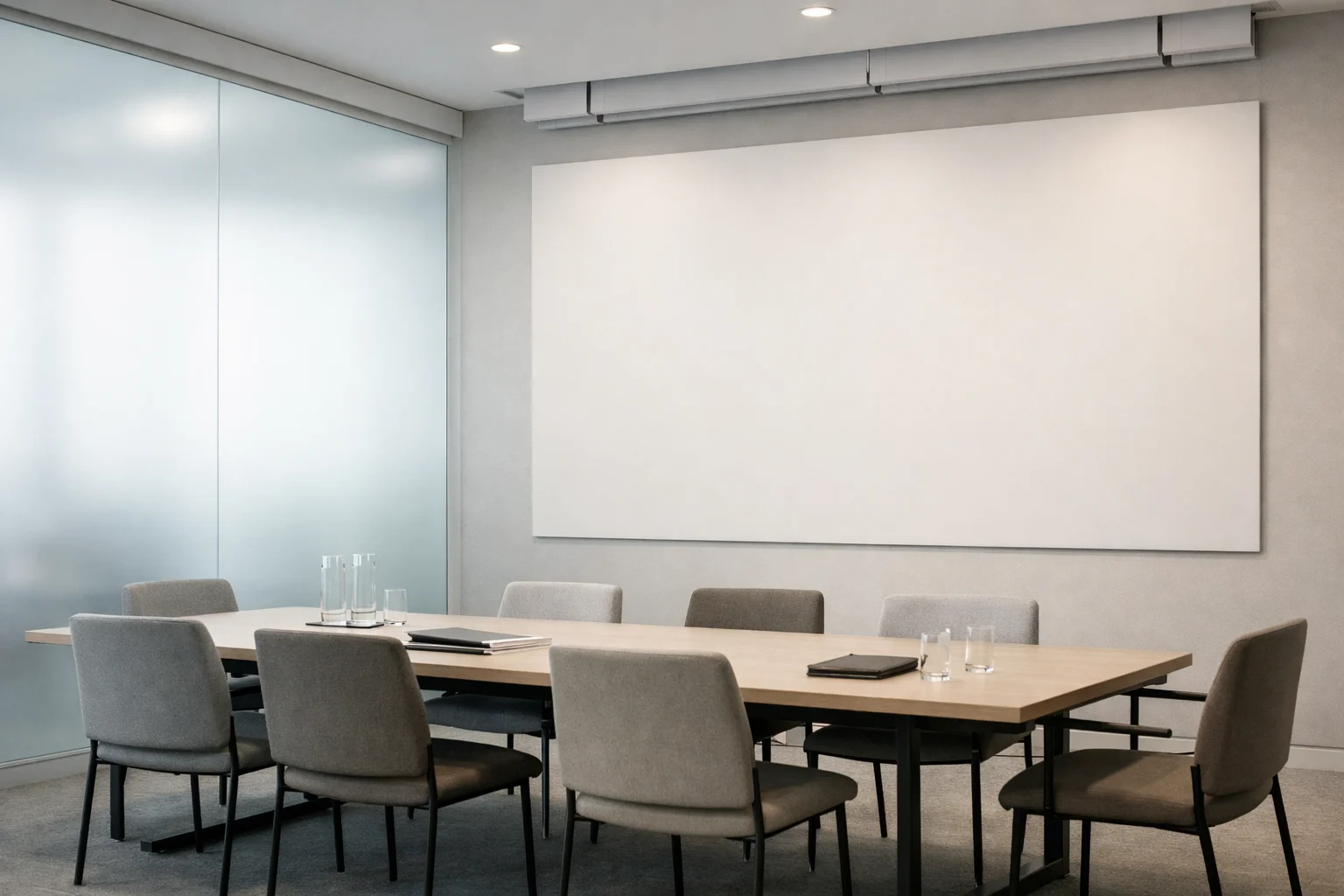
A glass-walled presentation room can support an open workplace aesthetic, but it can also introduce two distinct visual-control questions. One is whether people outside the room can see in during a confidential meeting, workshop, or client presentation. The other is whether the room can support the desired display, projection, or screen-viewing conditions.
Those questions should not be treated as one specification. Switchable privacy systems address on-demand visual privacy. Screen visibility, glare, ambient light, and true blackout are separate requirements that may call for shades, curtains, solar-control technology, or another purpose-built component. For commercial interior designers, defining the difference early can keep a glass-wall concept aligned with the room’s intended use.
Start with the room modes, not the product
Presentation rooms often serve more than one purpose. A room may be transparent and visually connected to an adjacent workplace between sessions, private during a client discussion, and visually controlled during a presentation. Each mode should be listed before selecting a solution.
- Open-room mode: The room remains visually connected to its surroundings.
- Privacy mode: Sightlines through the glass are obscured for a meeting or focused activity.
- Presentation mode: The team manages the viewing environment for the selected display or presentation method.
PDLC changes between transparent and translucent, frosted-looking privacy states. That can make it relevant to privacy mode, but it is not blackout film. A frosted glass state does not automatically establish the display conditions required by a particular screen, projector, or presentation format. The AV team and design team should identify the intended display approach rather than assuming a privacy layer performs a display function.
Why visual privacy and screen visibility should be briefed separately
“We need the glass to go private for presentations” can mean several different things. The team may be trying to limit views into the room, reduce distracting movement outside it, manage daylight, create a darkened environment, or support a specific display surface. These are not interchangeable needs.
On-demand visual privacy can be useful when occupants need to obscure activity inside a glass room without permanently frosting the partition. Blackout is a different requirement. So are solar control, glare management, and acoustic privacy. PDLC does not by itself provide acoustic privacy, and it should not be represented as a security-rated assembly without supporting documentation.
A clear brief lets the project team assign each task to the appropriate component. For example, a hybrid privacy system may combine PDLC with shades, curtains, or solar-control technology where the project needs more than visual privacy. Each element should be evaluated for its actual role, coordination needs, and added complexity.
Choose the privacy path based on the glass condition
Once the privacy function is defined, the next question is whether the project is working with existing glass or a new glass package. For suitable existing interior glass, PDLC smart film for suitable existing glass can often be retrofitted without replacing the glass. It requires electrical connection and control planning, and edges, wiring, sealing, glass condition, dimensions, installation quality, and site conditions can affect suitability.
For new construction, planned glass replacement, wet areas, or premium projects, laminated switchable privacy glass may be considered. In that product path, the PDLC is protected within a fabricated laminated assembly. It requires custom fabrication and early coordination between glazing and electrical scopes.
Neither route changes the need to separately evaluate the presentation environment. The choice between retrofit film and fabricated laminated glass concerns the privacy assembly and project condition; it does not establish that the room meets any particular blackout, projection, or screen-performance requirement.
Work with existing shades instead of treating them as a conflict
“We already have blinds or film” does not automatically end the conversation. Existing shades may already address a different room mode, such as solar control or blackout. A designer can assess whether those components should remain part of the room’s visual-control strategy while a switchable privacy layer serves a separate need.
This approach avoids a false either-or choice. Permanent frosting provides continuous obscurity. Shades and curtains can provide coverage and may be relevant where blackout is required. Switchable privacy glass or film provides on-demand visual privacy. In a room with multiple needs, retaining or specifying separate components can be more appropriate than expecting one system to perform every function.
For broader planning around glazed workplace environments, review office privacy glass for glass walls and conference rooms. The most useful design discussion identifies when occupants need openness, when they need visual privacy, and when the room needs a distinct display-control condition.
A practical coordination brief for a presentation room
Before finalizing a privacy solution, the design team can document the following items:
- The room activities that require transparent, private, and presentation modes.
- Whether the concern is sightlines, daylight, glare, blackout, display viewing, acoustic privacy, or a combination.
- The planned display method and the party responsible for validating its environmental requirements.
- Whether the glass is existing and suitable for retrofit or is part of a new fabricated glass package.
- The intended location of controls, electrical connections, wiring routes, and any transformers.
- How shades, curtains, or other visual-control components will operate alongside the privacy system.
- Who coordinates glazing, electrical, AV, interior design, installation, and final testing.
These are project questions rather than implied technical specifications. Dimensions, control methods, lead time, edge details, electrical requirements, and installation conditions should be confirmed for the actual room.
Design for the function the room actually needs
The benefit of glass partitions is often visual connection. The benefit of switchable privacy is the ability to obscure that connection when needed. A presentation room may also need additional visual control, but that does not turn a privacy product into a blackout or display solution.
Commercial teams planning flexible workplaces can explore smart glass for offices and conference rooms for relevant application context. When the room-mode brief, glass condition, and coordination responsibilities are clear, request a project review to discuss an appropriate privacy path.
Frequently asked questions
Can switchable privacy glass create blackout conditions for a presentation?
No. PDLC provides on-demand visual privacy by changing between transparent and translucent, frosted-looking privacy states. It is not blackout film. A room that requires blackout should evaluate a separate blackout solution.
Can existing shades remain in a room with switchable privacy glass or film?
They may remain relevant when they perform a separate function, such as coverage, solar control, or blackout. The project team should define how each component will be used and coordinate controls and installation for the actual room.
Is PDLC smart film appropriate for an existing glass presentation room?
It can often be retrofitted on suitable existing glass without replacing the glass. Glass condition, dimensions, edges, wiring, sealing, electrical planning, installation quality, and site conditions should be reviewed before selection.
Does switchable privacy glass provide acoustic privacy?
No. PDLC addresses visual privacy and does not by itself provide acoustic privacy. Rooms requiring speech privacy should assess separate acoustic measures.