
Curved glass is often used to make conference rooms, office pods, consultation spaces and premium interiors feel continuous and distinctive. The same geometry that creates that effect can make conventional blinds, curtains and permanent frosting difficult to use. PDLC Smart Film may offer privacy on demand on some existing curved surfaces, but it should not be specified as a universal solution.
The central distinction: applying Smart Film to compatible existing curved glass is a retrofit path. Fabricating laminated curved Smart Glass is a new-glass path. They require different evaluation, coordination and scope.
Why the curve matters
A flat film must conform to a three-dimensional surface without creating uncontrolled stress, distortion or edge problems. A gradual curve in one direction presents a different condition from a tight bend, an irregular profile or a surface that curves in multiple directions.
That is why no responsible assessment begins with a promise that Smart Film works on “any curve.” The review begins with the geometry and the glass.
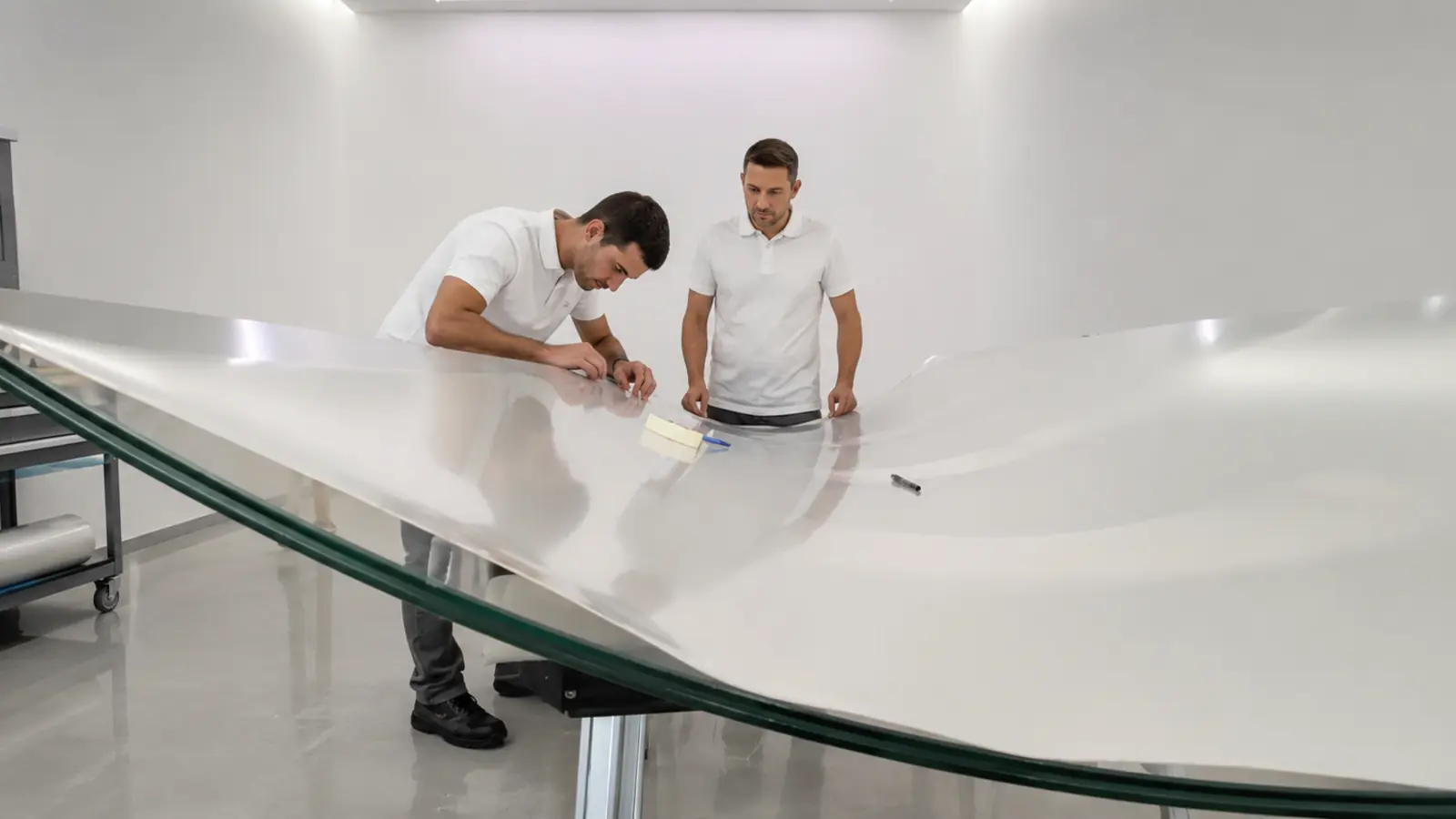
Curved applications require project-specific handling, edge and installation planning.
Curves that may be candidates for a retrofit review
Some gradual single-axis curves may be evaluated for an applied PDLC Smart Film solution. Compatibility still depends on more than the visible shape. The review normally considers:
- Curve direction and consistency.
- Overall glass dimensions and accessible working area.
- Glass type, condition, coatings and edge details.
- Interior or exposed environmental conditions.
- Electrical routing, controls and safe edge protection.
- Installation access and coordination with adjacent finishes.
Until those conditions are known, the correct status is project review required—not approved or guaranteed.
Installation access and the finished privacy state
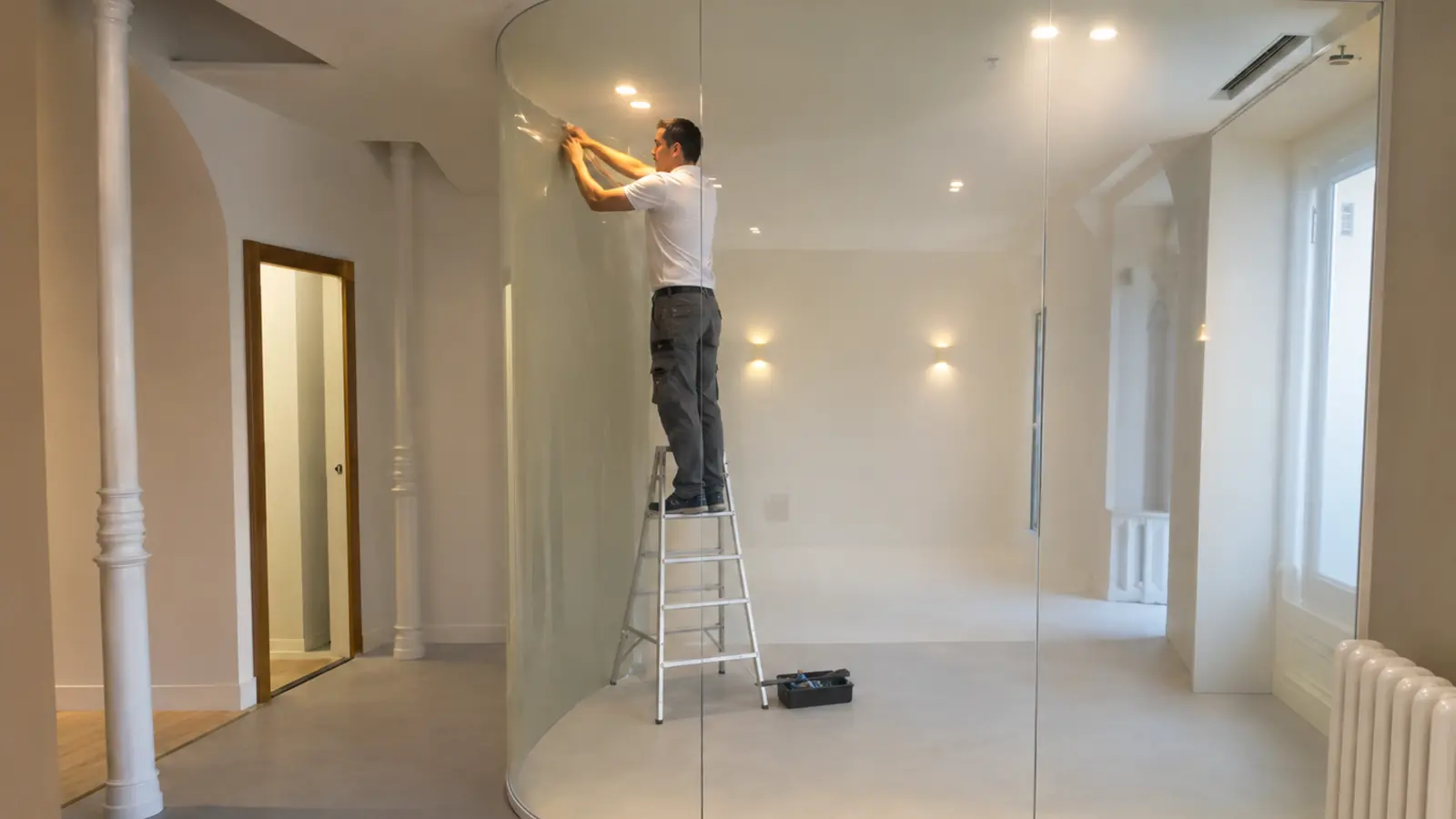
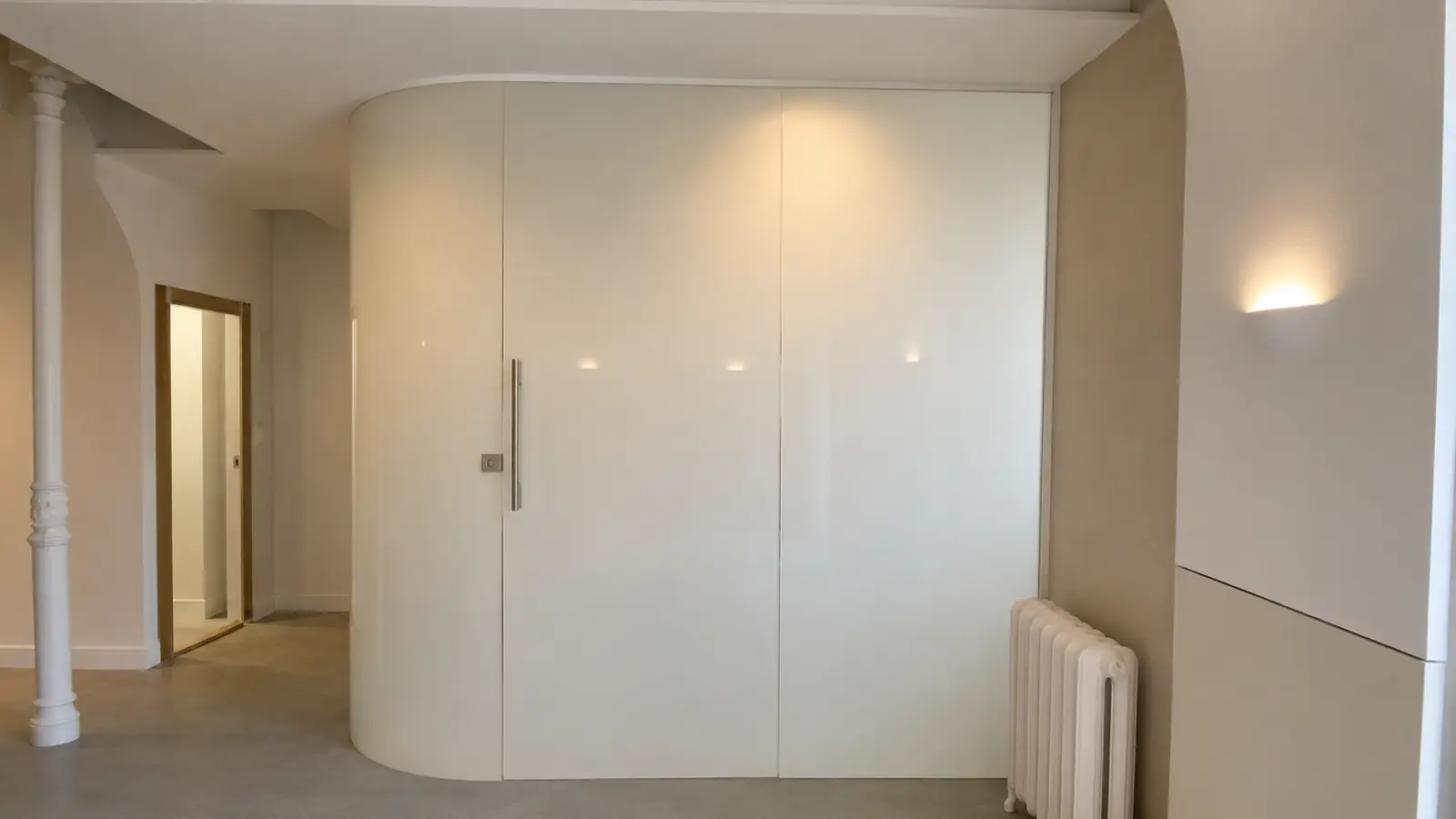
For an applied-film path, the installer must be able to reach the curved surface and its edges safely and continuously. The illustrative sequence below shows access during application and the corresponding enclosure in its translucent privacy state. It does not mean that every curve is compatible.
When laminated curved Smart Glass may be the better path
A new laminated glass assembly can be considered when the project is already specifying new curved glass, when the geometry is too demanding for a responsible retrofit, or when the architectural and fabrication requirements call for the PDLC layer to be integrated within the laminated assembly.
This path requires earlier coordination with the glass package. Fabrication, glass engineering, structural requirements and trade responsibilities must remain with the appropriately qualified parties.
| Existing curved glass + Smart Film | New laminated curved Smart Glass |
|---|---|
| Retrofit path for certain compatible surfaces. | Purpose-built new glass assembly. |
| Lower intervention when suitability is confirmed. | Requires fabrication and early coordination. |
| Glass condition, access and edges are critical. | Geometry and laminate design are considered during production. |
| Not appropriate for every curve. | Not represented as a universal answer for every geometry. |
Privacy does not mean blackout
PDLC privacy glass changes to a translucent state. It continues to transmit light and can show shadows or silhouettes depending on the lighting, distance and activity around the glass. Projects requiring total light blocking should not treat PDLC as a blackout material.
What to prepare for a feasibility review
The first contact can stay simple. A specialist can begin with your name, phone, email, city and ZIP code. During follow-up, the useful technical information may include photos from both sides, approximate width and height, any known curve data, glass details, site access, intended use and available drawings.
The objective is not to force a preferred product. It is to determine whether the project belongs on a Smart Film retrofit path, a laminated Smart Glass path, or another privacy solution entirely.
Have a live project? Use the Curved Switchable Smart Glass project page to compare the two paths and request a technical feasibility review.