
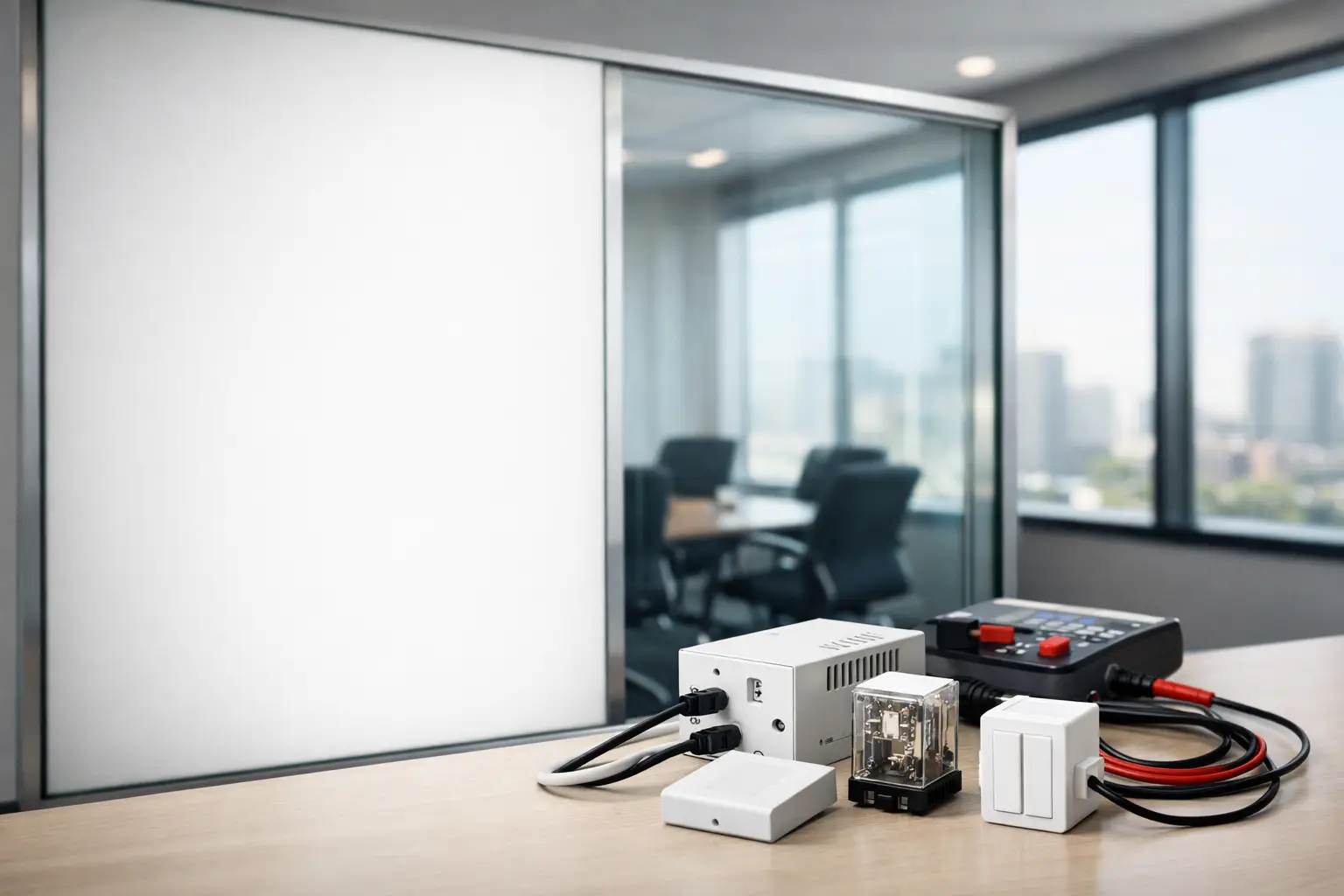
A privacy-glass partition can look like a simple glazing scope until the glass reaches the field with no approved route for power, no accessible transformer location, and no agreement on who owns controls. Switchable glass electrical requirements should be resolved during design development, not treated as a last-mile installation detail. The electrical path is part of the assembly.
For commercial interiors, the practical question is not simply whether power is available nearby. Project teams need to establish the correct product path, power demand, lead locations, zoning logic, controls, access for service, and responsibility between the glazing and electrical trades. Those decisions determine whether a project has a clean execution path or an expensive field workaround.
Start With the Correct Glass Path
Electrical planning begins with the distinction between existing glass and new glass. These are different scopes with different coordination demands.
Retrofit adhesive PDLC film is applied to existing interior glass. It can be an effective solution when the glazing is already installed and the project needs privacy-on-demand without replacing a complete partition system. The electrical connection still requires a planned route to the film busbars, typically managed at an edge of the lite and concealed where possible by framing, trim, or a purpose-built cover detail.
Fabricated laminated switchable glass is specified when new glass is being fabricated, when the glass must perform as a more complete architectural assembly, or where conditions demand a more durable integration. This is commonly the appropriate path for new partitions, shower glass, premium residential work, exterior-facing conditions, and projects where the glass itself must meet defined safety, thickness, edgework, or performance requirements. Lead locations, exits, and concealment should be approved before fabrication release. They are not details to improvise after tempered or laminated units arrive onsite.
The product path affects the electrical plan, but it does not eliminate it. Both retrofit film and fabricated smart glass need a defined connection strategy, appropriate power supply equipment, and an installation sequence that protects the active layer and its electrical terminations.
Switchable Glass Electrical Requirements by Scope
PDLC switchable glass operates on low-voltage alternating current supplied by a dedicated transformer or controller. The building electrical system provides line voltage to that equipment; the equipment then supplies the correct output voltage to the glass or film. Exact voltage, wattage, maximum circuit length, and permissible panel area vary by product configuration and manufacturer specification. They should be confirmed from the approved submittal, not estimated from a generic rule of thumb.
The relevant electrical load is usually modest compared with lighting or HVAC, but low load does not mean low coordination. Each zone requires sufficient transformer capacity, and transformer sizing should include the actual active glass area, required operating voltage, manufacturer limits, and sensible allowance for the intended control arrangement. A conference room with a single continuous privacy wall may operate as one zone. A clinic with multiple exam rooms may need separate zones so each room can control privacy independently.
Do not assume a single power supply can serve every lite in a large installation. Limits can apply to total load, lead length, wire gauge, voltage drop, and the manufacturer-approved number of panels per controller. Long runs may create inconsistent switching performance if the system is not designed around the approved electrical schedule.
Identify the electrical handoff
A disciplined scope assignment separates the work clearly. The electrician typically provides branch-circuit power, code-compliant raceway or wiring methods, disconnecting means where required, and connection to the transformer or control enclosure. The glazing team typically installs the glass or film, manages glass leads and approved low-voltage connections, and protects exposed terminations within the partition detail.
The exact division depends on the project contract and local practice. What matters is that it appears on drawings, in the scope matrix, and in the pre-installation conversation. “By others” is not an execution plan.
Plan transformer location early
Transformers, drivers, and controllers need an accessible location. Concealing them permanently above a hard ceiling, inside an inaccessible mullion, or behind a sealed wall finish creates a future service problem. Accessibility is especially important in healthcare, hospitality, executive interiors, and premium residential applications where the expectation is a finished appearance without sacrificing maintainability.
Locate equipment where it can be reached without disturbing finished glass, millwork, or critical operations. Consider ventilation requirements, permitted mounting orientation, proximity to the glass, and the route from line voltage to low-voltage output. Equipment should remain outside wet locations unless the selected equipment and installation method are specifically rated for that environment.
Coordinate Glass Leads With the Framing Detail
The most visible electrical mistake in a switchable glass project is often a lead that has nowhere acceptable to go. A clean elevation does not guarantee a buildable connection detail.
Before glass fabrication or film installation, confirm the lead exit side, lead orientation, wire path, framing cavities, cover profiles, and transition points to walls or ceilings. For frameless partitions, the detail may require a ceiling channel, perimeter trim, or another intentional concealment method. For framed systems, confirm that the framing can accommodate the wiring without pinching leads, compromising gaskets, or conflicting with anchors and door hardware.
Glass leads should not be cut, extended, spliced, or field-modified unless the approved product instructions expressly allow that method. The active layer, busbar connections, and edge seal are part of the system. A shortcut that appears minor during installation can affect appearance, switching quality, warranty support, and long-term reliability.
For fabricated assemblies, lead exits should be shown on approved shop drawings with dimensions referenced to the glass orientation. For retrofit film, field verification of the existing glass, adjacent frame conditions, and available wire routes is essential before material is ordered. Existing conditions often decide whether a retrofit scope remains clean and commercially viable.
Controls Are a Design Decision, Not an Afterthought
Switchable glass can be controlled by a standard wall switch, a low-voltage control station, a relay, a building automation interface, occupancy logic, or another approved control method. The appropriate choice depends on how the room is used.
A meeting room may benefit from a local switch near the entry and an additional control point at the conferencing location. A healthcare treatment room may require simple, immediate staff control. Hospitality applications may need guest-facing controls that remain intuitive. In executive settings, central control may be desirable, but it should not create a confusing operational sequence for the people in the room.
Specify the normal state intentionally. Most PDLC privacy glass is transparent when energized and private when power is off. That means a power interruption changes the visual state of the glass. For many applications, that is a useful privacy-first condition. For others, the project team should evaluate operational expectations, emergency procedures, and the effect of a planned shutdown.
Switchable glass is generally not a dimmable lighting load. Do not place it on a conventional dimmer or assume it can share a lighting-control circuit without confirming compatibility. Control equipment, relay ratings, switching frequency, and automation integration should follow the approved system design.
Wet Areas and High-Expectation Environments
Showers, spa areas, and other wet environments require greater reference discipline. The smart-glass assembly, edge treatment, lead exit, sealing approach, enclosure design, transformer location, and electrical protection all need to work together. A privacy layer does not make an ordinary interior film installation appropriate for a wet-glazing application.
This is one reason fabricated laminated smart glass is generally the serious execution path for shower glass and demanding architectural conditions. The glazing assembly must be selected for the environment before electrical details are finalized. The electrical equipment should remain in a dry, accessible location, with routing and protection coordinated according to applicable code and approved installation requirements.
Exterior-facing applications require the same caution. Performance expectations extend beyond privacy switching to the full insulated, laminated, or safety-glazing assembly. Electrical provisions must be coordinated with the complete glass build-up, not treated as an accessory added after the façade or enclosure is designed.
Build an Electrical Schedule Before Release
A concise electrical schedule prevents avoidable ambiguity. For each privacy-glass zone, document the glass or film type, active dimensions, total active area, lead location, transformer or controller model, calculated load, line-voltage source, low-voltage wire route, control method, and responsible trade. Include a unique zone identifier that matches plans, elevations, shop drawings, and field labels.
This schedule becomes particularly valuable when a project has multiple rooms, mixed glass types, phased installation, or separate electrical and glazing subcontractors. It also supports accurate quoting. A price for smart glass without power supplies, controls, routing details, and commissioning is not a complete installed solution.
Before turnover, test every zone with the project team. Confirm clear and private states, verify switch locations and automation behavior, inspect lead concealment, label service equipment, and provide the final control information to the facility representative. Commissioning is brief when the system was coordinated early. It becomes much harder when electrical decisions were deferred until the glass is already installed.
The right electrical plan does more than make switchable glass operate. It preserves the design intent, keeps service practical, and gives the glazing, electrical, and design teams a project they can stand behind.