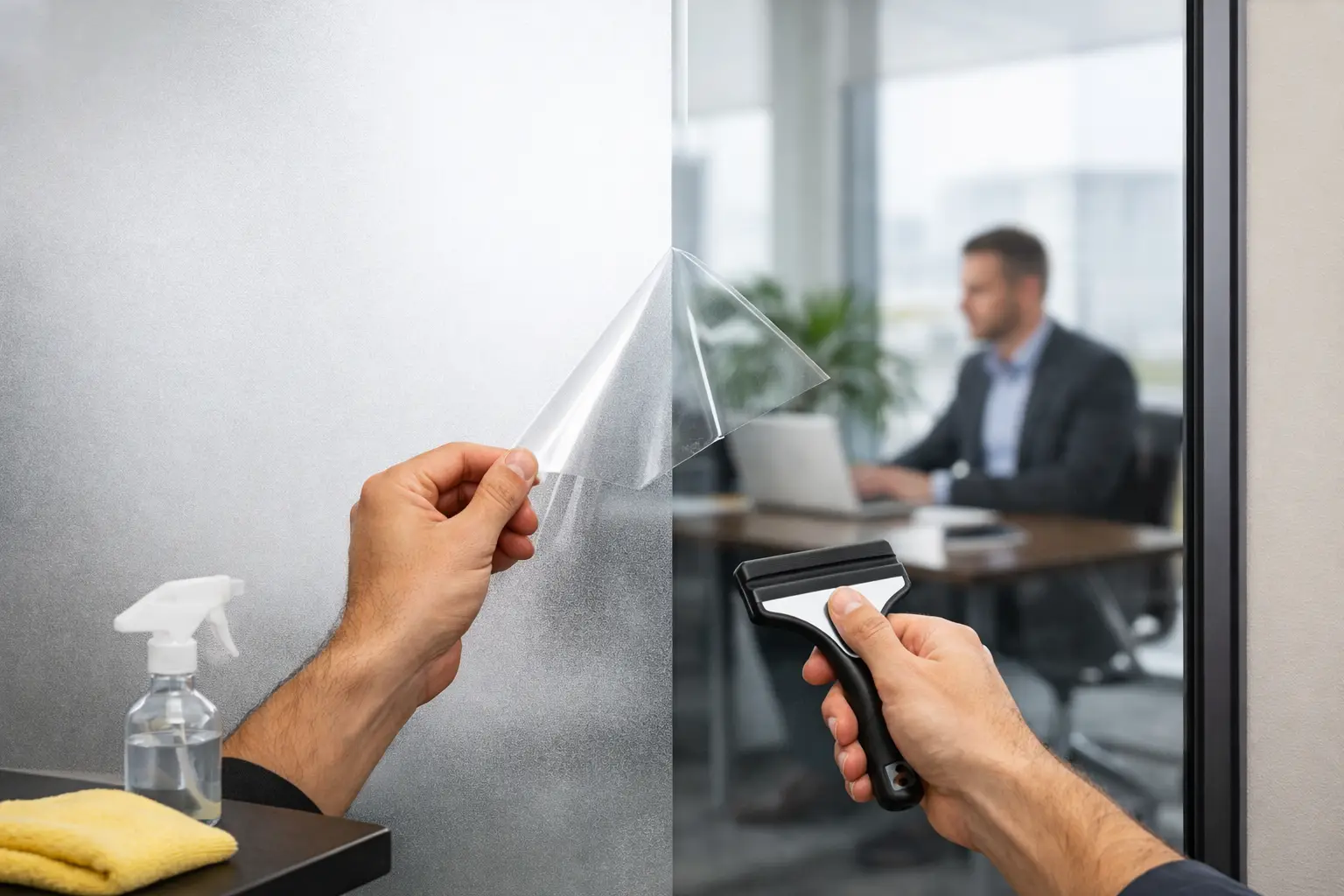
A conference room with clear sidelites may be architecturally correct until the first confidential meeting begins. For projects where the glass is already installed and replacement is not justified, retrofit privacy film for existing glass can provide controlled opacity without rebuilding the partition system. The value is real, but so is the need for disciplined qualification. Retrofit PDLC film is not simply a decorative window treatment. It is an electrically operated architectural component with visual, electrical, substrate, and installation requirements that should be reviewed before a price is issued.
For commercial teams, the right first question is not, “What does the film cost?” It is, “Is the existing glazing a suitable platform for a retrofit privacy-film assembly?” That distinction protects the design intent, the installation channel, and the project schedule.
What Retrofit PDLC Film Is Designed to Do
Retrofit PDLC smart film is an adhesive-backed liquid crystal film applied to an existing interior glass surface. In its unpowered state, the film presents a frosted, private appearance. When powered, the liquid crystals align to create a transparent viewing condition. It is commonly selected for office fronts, conference rooms, private consultation spaces, executive interiors, clinic partitions, hospitality settings, and other interior applications that need privacy on demand without permanent visual blockage.
The product is particularly useful when an existing glass-wall system is in good condition, the client wants to preserve daylight and openness, and the construction scope does not support removing and replacing glazing. It can also be a practical answer when late-stage programming changes create a need for occasional privacy after the partitions are already in place.
The transparent state should be described accurately. PDLC film becomes clear enough for normal visual connection and daylight transmission, but it is not identical to uncoated architectural glass. Some haze is inherent to the technology. Teams specifying the film for high-definition display surfaces, critical exterior views, or applications with exceptionally demanding optical expectations should evaluate a physical sample and, where appropriate, a representative mockup.
Is Existing Glass the Right Substrate?
The existing glass must be assessed as part of the system, not treated as a neutral background. Retrofit film performs best on clean, sound, flat interior glass with accessible edges and a stable surrounding frame or partition condition. A site review should identify scratches, chips, failed seals, old adhesive residue, coatings, decals, uneven surfaces, and conditions that could interfere with adhesion or visual quality.
Tempered glass is often compatible for interior retrofit work, but the project team still needs to verify the specific panel configuration, access, and intended location. Patterned, textured, heavily etched, damaged, or irregular glass may not produce an acceptable finish. Existing film, applied graphics, or privacy bands should generally be removed rather than covered unless the installation team has confirmed the substrate condition.
Glass dimensions matter as well. Oversized panels can require careful film segmentation, panel-specific electrical planning, and a deliberate approach to seams. A seam may be acceptable within a mullion line or a noncritical visual zone, but it should never become an unreviewed field decision. The design team, dealer, and installer should agree on panel layout before fabrication begins.
Interior Retrofit Versus Fabricated Smart Glass
This is the decision point that prevents a large share of misquoted work. Retrofit adhesive PDLC film is intended for existing interior glass where the surface is accessible and the application fits the product path. Fabricated laminated smart glass is a different assembly. The PDLC layer is encapsulated within the glass build-up during fabrication, providing a more protected and durable solution for new construction and demanding architectural conditions.
If the project involves new glass, shower enclosures, wet environments, exterior-facing locations, exposed edges, frequent washdown, or a high-risk occupancy condition, fabricated smart glass should be evaluated instead of assuming retrofit film is appropriate. The same is true when the privacy technology must be integrated into a custom insulated, laminated, fire-rated, or specialty glazing assembly.
This is not a matter of upgrading by default. It is about selecting the correct construction for the environment. Retrofit is often the efficient execution path for a qualified existing-glass interior project. Fabricated smart glass is often the more appropriate path when the glass itself must be engineered around the technology.
Electrical Planning Is Part of the Scope
PDLC film requires low-voltage power through a dedicated transformer or power supply. Each panel or grouped zone needs a planned power path, suitable controls, and coordination with the electrical scope. Treating wiring as an afterthought can compromise the clean visual result that made switchable privacy attractive in the first place.
Before approving the layout, the project team should establish where power will originate, how conductors will travel to each panel, whether mullions or framing can conceal wiring, and where transformers and controls will be located for access and service. Ceiling cavities, adjacent millwork, head channels, and wall returns can all offer viable pathways, but each must be confirmed against actual field conditions.
Control requirements should also be resolved early. A basic wall switch may be appropriate for a small conference room. A clinic may need grouped control by room, while a hospitality or executive project may require integration with lighting controls, automation, occupancy logic, or a building management platform. The controls discussion should include the desired default condition during power loss. Because standard PDLC film is private when unpowered, a power interruption returns the film to its opaque state. For many privacy applications, that is a useful fail-safe condition. It should still be intentional.
A Clean Installation Depends on Reference Discipline
The visible quality of retrofit film is strongly influenced by field preparation and installer capability. Glass must be thoroughly cleaned and prepared. Film must be cut, positioned, applied, electrically connected, and finished without contaminating the adhesive surface or creating avoidable edge issues. Dust, moisture, poor alignment, trapped debris, and rushed handling can remain visible long after the crew leaves the site.
For that reason, qualified commercial projects should be assigned to capable glass, wall-system, or specialty installation partners familiar with precision interior finishes. The film installation should be sequenced after dusty trades have substantially completed their work and before the area is turned over for final cleaning and occupancy. If millwork, access-control hardware, audiovisual equipment, or window treatments will meet the glass, those interfaces should be coordinated in advance.
A representative sample helps establish expectations for haze, frosted appearance, edge treatment, wiring visibility, and transparent-state clarity. On larger or highly visible projects, a mockup is often the responsible choice. It gives the architect, owner, and installation team a shared reference before multiple rooms are committed.
Where Retrofit Privacy Film Creates the Most Value
Retrofit is most compelling when the existing glass already supports the architectural intent. An office can remain open during normal operations and become private for board discussions. A medical consultation room can provide discretion without sacrificing borrowed light. A hospitality suite can shift from an open layout to a screened environment without adding blinds, curtains, or permanent frosted glass.
The technology also has a planning advantage over manually operated privacy treatments. It can be controlled at the wall, through an automation system, or in a programmed zone, allowing the privacy condition to align with room use rather than relying on occupants to lower shades or close coverings. That benefit is strongest when the client has a clear operational reason for dynamic privacy.
It is less compelling when permanent opacity would meet the need at lower complexity, when the glass is rarely used as a visual boundary, or when the project environment exceeds the retrofit film’s appropriate exposure conditions. Smart glass should solve a defined spatial and operational problem, not become an unexamined finish upgrade.
The Project Review Questions That Matter
A serious execution path starts with a focused review: Is the glass existing or new? Is the application interior, dry, and accessible? What are the panel sizes and glass types? Where will power, transformers, and controls be located? How will wiring be concealed? What transparency and privacy expectations does the owner have? Who will install, coordinate, and service the system?
Those answers shape the correct quote and prevent the most common disconnect: pricing adhesive retrofit film for a condition that really requires fabricated laminated smart glass. They also help the project team identify whether the existing framing, electrical rough-in, and construction schedule support a clean installation.
Smartglass USA approaches retrofit work as a coordinated architectural component rather than a consumer film purchase. That means the product path, electrical concept, panel layout, and installation responsibility should be aligned before the project moves into procurement.
When existing interior glass is sound, accessible, and part of a well-coordinated commercial scope, retrofit PDLC film can add a precise layer of privacy without sacrificing the openness that glass was selected to create. The best next step is a project review grounded in actual drawings, panel conditions, control intent, and the installation partner who will carry the work into the field.