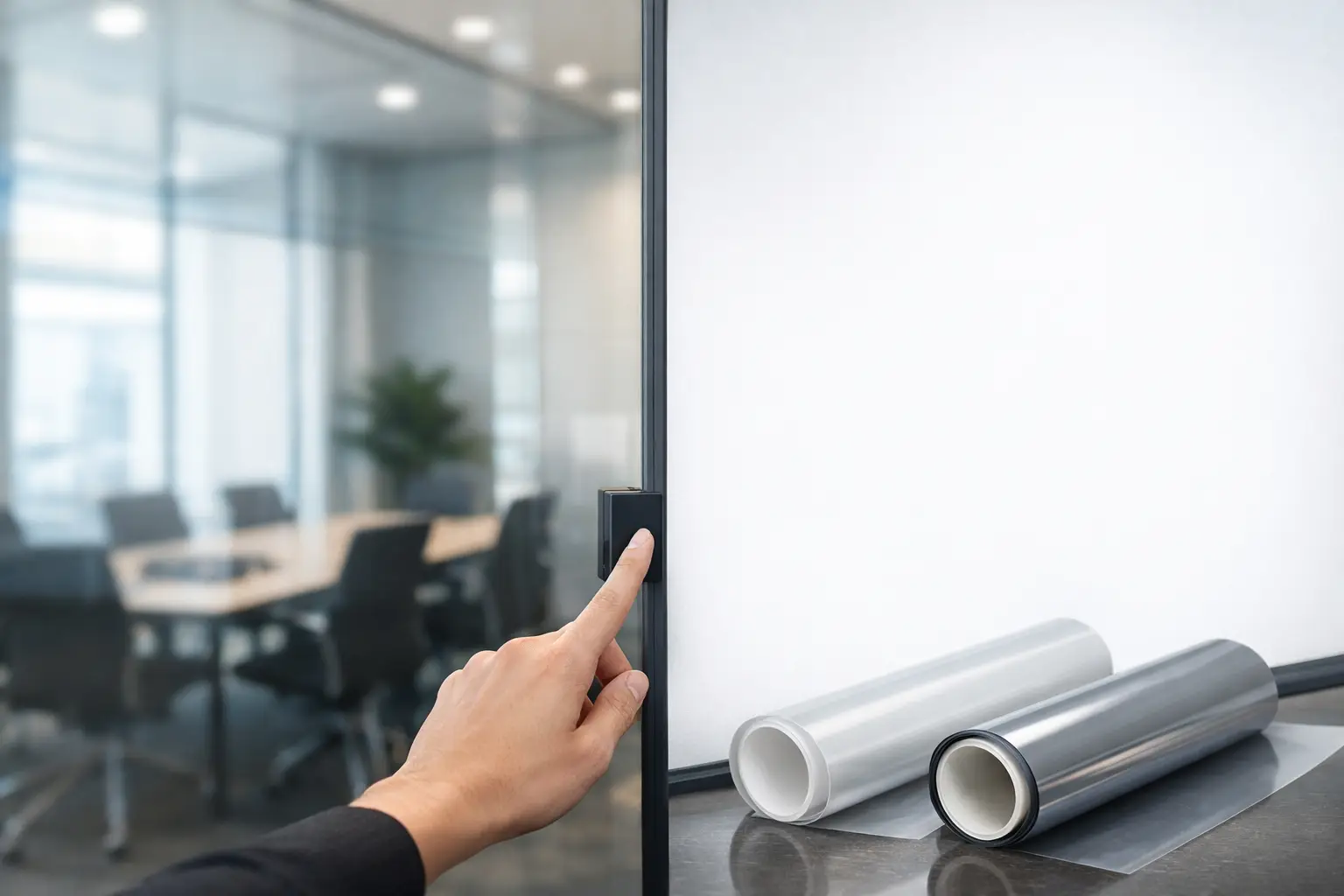
A conference room can have premium glass partitions, clean sightlines, and a carefully planned interior - then lose all of its value the moment a confidential meeting begins. PDLC smart film addresses that problem by turning compatible existing glass from clear to private at the touch of a switch. The material is compelling, but it is not a universal answer for every glass condition, location, or project type.
For commercial teams, the central decision is straightforward: is this an existing interior glass retrofit, or does the project require a fabricated smart-glass assembly? Getting that distinction right early protects the quote, the schedule, and the finished appearance.
What PDLC Smart Film Does
PDLC stands for polymer dispersed liquid crystal. In its powered state, the liquid crystals align to allow light through, creating a clear viewing condition. When power is removed, the crystals scatter light and produce a frosted privacy effect. The change is immediate enough for meeting rooms, healthcare consult spaces, executive offices, hospitality suites, and other environments where visibility needs to be controlled on demand.
The privacy state is not a blackout condition. Light still passes through the film, and silhouettes may remain visible when a person is close to the glass or when lighting is unbalanced between the two sides. This is usually an advantage in architectural interiors because it preserves daylight and the visual openness of a glass-wall system. It also means project teams should define “privacy” precisely before specifying the product.
For the right application, retrofit film allows a finished glass partition to gain controlled opacity without removing and replacing the glazing. That can be a practical path when the glass is already installed, the system is interior-facing, and the project can accommodate electrical coordination.
Retrofit Film Versus Fabricated Smart Glass
This is the specification line that matters most. Adhesive PDLC film is applied to an existing pane, typically on the interior-facing surface where it is protected from weather, cleaning exposure, and physical abuse. It is best evaluated as a retrofit solution for stable, accessible interior glass.
Fabricated smart glass is different. The PDLC layer is incorporated within a laminated glass assembly during fabrication. That construction is the appropriate path when the smart-glass function must be protected within the glazing, when the glass itself is being supplied new, or when the project has more demanding architectural requirements.
When retrofit film is the appropriate path
Retrofit PDLC film is often a strong fit for office fronts, conference-room partitions, internal clinic glazing, executive suites, training rooms, and selected hospitality interiors. These projects usually share three characteristics: existing glass is in good condition, the glass can be accessed for a controlled installation, and power can be routed cleanly to each film panel.
It is particularly useful where demolition would disrupt an operating workplace or where a design team wants to preserve an existing glass-wall system. The film can provide a significant privacy upgrade while maintaining the original framing and general layout.
When fabricated smart glass is the better decision
New construction, shower glass, exterior-facing glazing, wet environments, and installations exposed to frequent direct contact should be reviewed as fabricated smart-glass projects. The same applies when the specified glass must meet a particular safety, thickness, acoustic, tint, or performance requirement as part of a complete assembly.
A retrofit film should not be used to force an interior solution into an exterior or wet-area condition. That decision may appear to reduce first cost, but it shifts risk to edges, electrical connections, long-term appearance, and warranty alignment. A serious execution path starts with the correct product architecture, not the lowest apparent material price.
Conditions That Determine Whether Existing Glass Can Be Retrofitted
Not every installed pane is ready for film. A project review should confirm the glass type, panel dimensions, framing configuration, accessibility, and current condition before a proposal is finalized. Surface quality matters because adhesive film will not conceal scratches, chips, coating irregularities, adhesive residue, or distortion in the glass behind it.
The glass must also be clean, flat, and reachable with enough working room for precise installation. Mullions, door hardware, silicone joints, narrow edge clearances, and complex cutouts all affect fabrication and field labor. A rectangular office lite is materially different from a door panel with hardware penetrations or a partition that terminates tightly into custom metalwork.
Film sizing deserves reference discipline. Panels are fabricated to the glass dimensions and job-specific electrical layout, not simply ordered by nominal opening size. Field verification should account for visible glass, edge setbacks, busbar placement, and the location where lead wires will exit the panel. A small measuring error can become a visible alignment issue once the film is installed.
Electrical Coordination Is Part of the Glass Scope
PDLC smart film is an electrical architectural finish. It needs power, wiring, switching, and a practical path for concealing connections. Those requirements should be coordinated before fabrication, not handled as an afterthought when the film installer arrives on site.
Each panel or controlled group requires an appropriate power supply. Depending on the project, privacy can be managed with a wall switch, remote control, automation interface, occupancy logic, or a room-control system. The preferred approach depends on how the space is used. A clinic may need simple, immediate local control, while a corporate boardroom may require integration with audiovisual and scheduling controls.
The electrical team and glazing team need clear responsibility boundaries. Who provides the branch power? Where will transformers or power supplies live? How will low-voltage leads move through frames, ceilings, or adjacent millwork? Who makes final connections, and who verifies operation after installation? These are ordinary coordination questions, but they determine whether the final installation looks integrated or improvised.
Power-off privacy should also be intentional. Standard PDLC configurations are generally private when unpowered and clear when energized. For many conference rooms and clinical applications, that is the preferred fail state. It protects privacy during a power interruption, but it also means electrical design must account for the normal powered condition.
Design Expectations That Should Be Set Early
Smart film changes how a room performs, but it does not replace every other visual-control strategy. It offers diffuse privacy rather than a clear view with variable tint. If the design objective is solar control, glare reduction, room darkening, or a projected image surface, the team may need complementary shades, lighting controls, or a different glass specification.
Lighting is especially relevant. A bright corridor facing a dark conference room can create more visible silhouettes in the private state than a balanced lighting condition. Designers should review the actual use scenario, including evening operation, display lighting, and interior light levels on both sides of the partition.
The powered state should also be evaluated against the project's visual standard. PDLC film is designed for clarity, but it will not make ordinary glass disappear. Existing glass quality, reflections, panel joints, busbar locations, and surrounding frame geometry remain part of the visual result. Premium projects benefit from a sample review or a clearly understood reference condition before broad installation.
Installation Quality Protects the Result
A clean PDLC installation requires trained handling, controlled surface preparation, accurate alignment, and disciplined electrical finishing. Dust, moisture, poor trimming, trapped contamination, or rushed lead management can be highly visible on a glass partition intended to look refined.
The installer should understand both film application and commercial glass conditions. This is not simply a decorative window-film task. The work interfaces with architectural finishes, low-voltage components, access constraints, and client expectations for uniformity across multiple panels.
Project sequencing matters as well. Film should not be installed while nearby construction activities are still generating dust, overspray, or repeated impact risk. If the room will receive final paint, millwork, ceiling work, or hardware adjustments, the installation team needs a protected and coordinated window of access.
For qualified commercial projects, Smartglass USA approaches PDLC film as a coordinated architectural scope rather than a consumer product transaction. The objective is to align the existing glass condition, electrical plan, fabrication details, installation channel, and performance expectation before material reaches the site.
A Better Starting Point for Project Teams
Before requesting a final price, prepare the information that allows the project to be reviewed correctly: glass dimensions and photos, location of each pane, framing details, intended control method, power availability, project schedule, and the required privacy condition. If the glass is new or the installation is wet, exterior-facing, or performance-critical, identify that immediately so the fabricated smart-glass path can be evaluated instead.
The most successful privacy-glass projects are rarely the ones that begin with a square-foot price alone. They begin with a clear distinction between existing glass and new glass, then give the right partners enough information to execute the selected path without compromise.