A conference-room partition is already installed, the glass is sound, and the client needs privacy before occupancy. That is a retrofit question. A new shower enclosure, a high-traffic lobby wall, or an exterior-facing opening is a fabrication question. The PDLC film vs laminated smart glass decision becomes straightforward when the project team begins with that distinction rather than comparing products by appearance alone.
Both systems use polymer dispersed liquid crystal technology to switch between a frosted privacy state and a clear state when powered. Both can support an elevated, controlled-visibility experience. They are not, however, interchangeable construction methods. The correct choice affects the glass package, electrical coordination, durability expectations, field labor, schedule, and ultimately the execution path for the project.
PDLC Film vs Laminated Smart Glass: The Core Difference
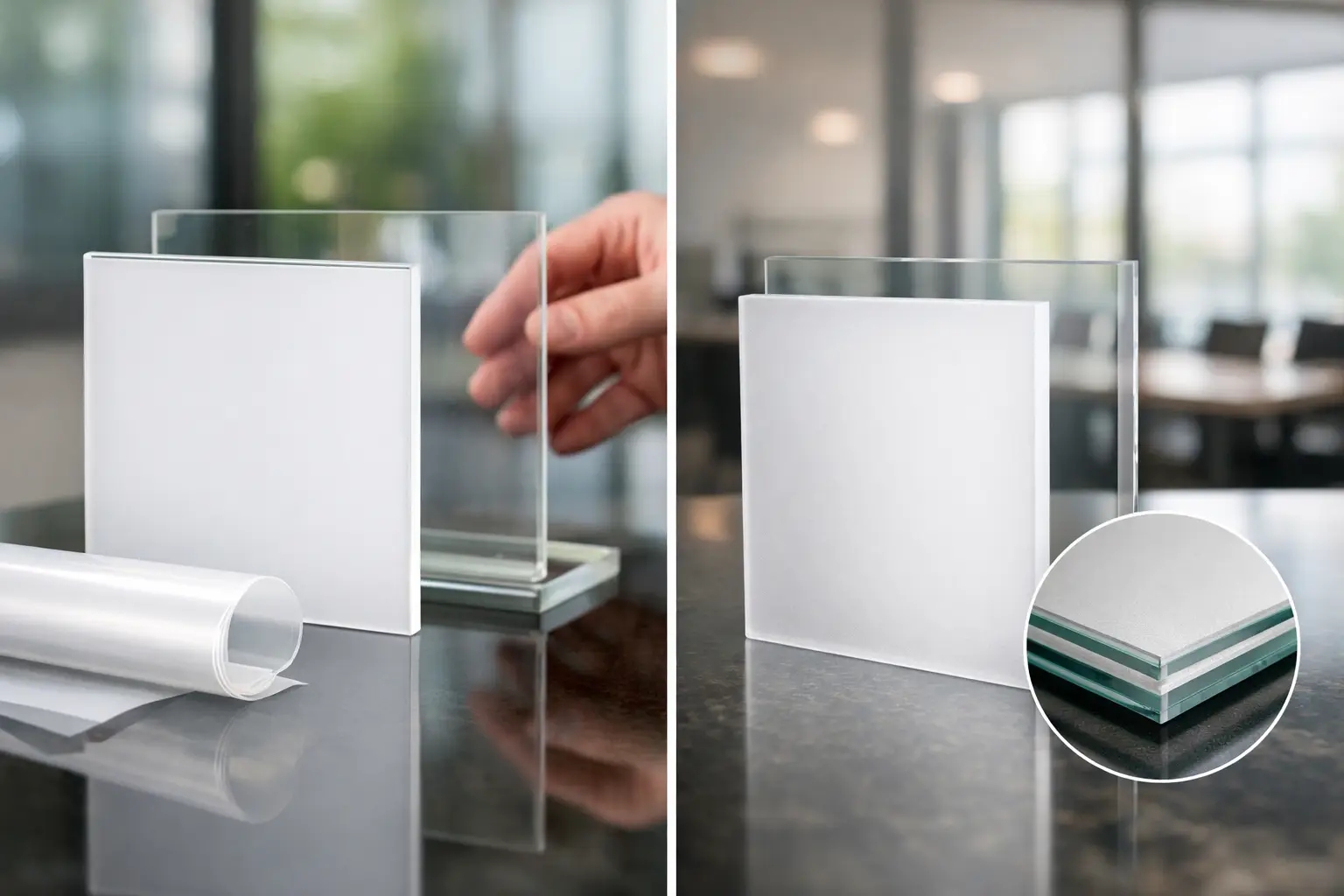
Retrofit PDLC smart film is an adhesive-backed switchable layer applied to an existing interior glass surface, typically on the room side of a partition or glazing system. It is intended to add privacy control without removing and replacing otherwise suitable glass. For an occupied office, healthcare consultation room, executive suite, or conference space, that can preserve the existing framing and substantially reduce disruption.
Laminated smart glass is a fabricated glass assembly. The PDLC layer is enclosed between glass lites during fabrication, creating a protected, integrated switchable glazing unit. It is specified as new glass, not applied to completed glass in the field. That construction makes it the appropriate path when the glass itself must meet more demanding architectural, safety, wet-environment, or exposure-related requirements.
The visual result can appear similar from a distance. The project requirements behind each result are materially different. A team that quotes adhesive film as though it were a replacement for a fabricated safety-glass assembly can create a problem long before installation begins.
When Retrofit PDLC Film Is the Right Path
PDLC film is generally the practical choice where existing interior glass is staying in place and the objective is privacy-on-demand. Typical applications include interior sidelites, glass office fronts, conference-room walls, clinic consultation areas, training rooms, and selected hospitality partitions.
Its central advantage is preservation of the installed condition. There may be no need to remove glazing stops, alter a glass-wall system, order replacement lites, or expose an occupied space to an extended glazing operation. For renovation work, particularly where the base building or tenant improvement package is already complete, that can be the most commercially sensible route.
Retrofit does not mean casual installation. The glass must be evaluated for condition, dimensions, accessibility, edge details, and surface preparation. The film requires a clean application environment and disciplined handling to achieve a clean visual result. Electrical leads, busbar orientation, power supply location, controller selection, and wire concealment should be coordinated before field work starts, not solved after the panels are installed.
Film also has clear application boundaries. It is best suited to protected interior surfaces. It should not be treated as a universal surface layer for showers, exterior glass, exposed high-moisture areas, or locations where cleaning, abrasion, impact, and environmental conditions exceed what a field-applied interior finish can reasonably support.
For a qualified commercial retrofit, the important question is not simply whether film can adhere to the glass. The question is whether the existing glass, surrounding system, electrical route, and use conditions support a project-grade result.
When Laminated Smart Glass Is the Better Specification
Laminated smart glass is the serious execution path when a project involves new glazing or when the switchable element needs to live inside a purpose-built glass assembly. Because the PDLC layer is protected between lites, the assembly is better aligned with applications that require safety glass, enhanced durability, direct water exposure, or a more integrated architectural finish.
Shower glass is a common example. A shower enclosure introduces water, cleaning cycles, hardware interfaces, and safety-glazing requirements. Applying a retrofit film to an existing shower panel does not convert that panel into a fabricated, safety-rated switchable glass assembly. A laminated configuration can instead be developed around the required glass type, thickness, edgework, hardware preparation, and project-specific installation conditions.
The same logic applies to new office partitions, premium residential glazing, hospitality environments, healthcare projects, and exterior-facing conditions where the glass package must be coordinated as a whole. Depending on the application, that coordination may involve tempered or heat-strengthened glass, interlayer requirements, insulating glass construction, performance targets, edge concealment, and framing compatibility.
Fabricated smart glass also gives design and glazing teams greater control over the final assembly. The PDLC layer, conductive busbars, wire exits, and protective glass layers are considered before fabrication. This can produce a cleaner architectural result than attempting to add privacy technology after the glass system is complete, especially on highly visible installations.
That does not mean laminated smart glass is automatically the premium answer for every project. It usually carries longer fabrication coordination, higher material cost, and a different installation sequence than retrofit film. If the existing interior glass is already appropriate and schedule pressure is high, replacing it with laminated smart glass may add cost without solving a real requirement.
Start With the Project Condition, Not the Product Name
A disciplined specification review starts by defining whether the project is existing glass or new glass. From there, the decision usually becomes more precise.
For existing interior glass, evaluate whether the glass is flat, accessible, in good condition, and located in a protected environment. Confirm that electrical components can be routed and concealed in a manner consistent with the design intent. Then determine whether the privacy requirement is visual only or whether the application also carries safety, water, acoustic, structural, or exterior-performance demands. If it is primarily a visual privacy retrofit, PDLC film may be the appropriate solution.
For new glass, begin with the architectural and code-related needs of the opening. Is the glass in a shower? Does it require a safety-glazing configuration? Is it part of an exterior envelope? Will it receive heavy use, repeated cleaning, or direct contact? Is the design team expecting finished edges, custom shapes, hardware cutouts, or a specific framing system? These are laminated smart-glass conversations because the privacy technology must be coordinated with the glazing assembly itself.
This approach also prevents a common procurement error: comparing film by square foot against fabricated smart glass by square foot. The numbers may look comparable on a spreadsheet, but they represent different scopes. One is a retrofit layer installed onto existing glass. The other is a fabricated glazing product with its own glass, processing, safety, handling, freight, installation, and coordination requirements.
Electrical Coordination Is Part of the Glass Scope
Every switchable privacy-glass project needs a clear electrical plan. PDLC changes state through a low-voltage power system, but the project still requires properly located power supplies, accessible service considerations, wire paths, switching controls, and responsibility assignments among the electrical contractor, glazier, installer, and controls team.
For retrofit film, lead placement and wire concealment can be especially important because the surrounding glass and framing already exist. A clean installation may require careful review of mullions, ceiling conditions, adjacent millwork, and pathways back to power. A technically possible route is not always an acceptable design route.
For laminated smart glass, electrical exits should be established during the fabrication process. The glazing contractor needs accurate information about orientation, setting sequence, protection of leads, and transition points to the building wiring. Reversing a panel or discovering an inaccessible wire exit after delivery is an avoidable coordination failure.
Controls should be selected for the actual operating requirement. A simple wall switch may suit a small conference room. Larger projects may need grouped zones, remote control, occupancy logic, building automation integration, or distinct privacy settings by room. The glass technology is only one component of the user experience.
Appearance, Performance, and Client Expectations
In the powered clear state, PDLC products are transparent but should not be presented as identical to ordinary monolithic clear glass. The layer can affect haze, tint, and viewing clarity depending on the product configuration, lighting, viewing angle, and surrounding conditions. In the unpowered privacy state, the material diffuses light and obscures direct views, but it is not a blackout solution.
That distinction matters in healthcare, executive settings, and hospitality suites. If the client needs full light blockage, a separate shading strategy may be necessary. If the client needs confidential visual separation while preserving borrowed light, switchable privacy glass is often well suited.
Mockups are valuable when a project has exacting visual expectations. They allow the team to assess clear-state appearance, privacy-state opacity, edge treatment, lighting behavior, and control response in conditions closer to the finished environment. For premium installations, reference discipline is preferable to assumptions based on small samples or online imagery.
A Better Way to Qualify the Opportunity
The fastest route to an accurate recommendation is a concise project brief: existing or new glass, location, dimensions, application type, desired privacy behavior, electrical availability, drawings or photos, and target installation timing. For fabricated work, include glass requirements, hardware details, framing information, and any exposure or safety considerations. For retrofit work, include close photographs of the glass edges, mullions, and nearby routes for power.
Smartglass USA approaches these decisions as a project-fit exercise, working with capable glazing, design, fabrication, and installation partners to distinguish a viable retrofit from a fabricated assembly that should be specified from the start.
The useful closing question is simple: are you adding privacy control to suitable existing interior glass, or are you designing the glass itself for the demands of the opening? Answer that correctly at the outset, and the appropriate PDLC path becomes far easier to price, coordinate, and deliver.