
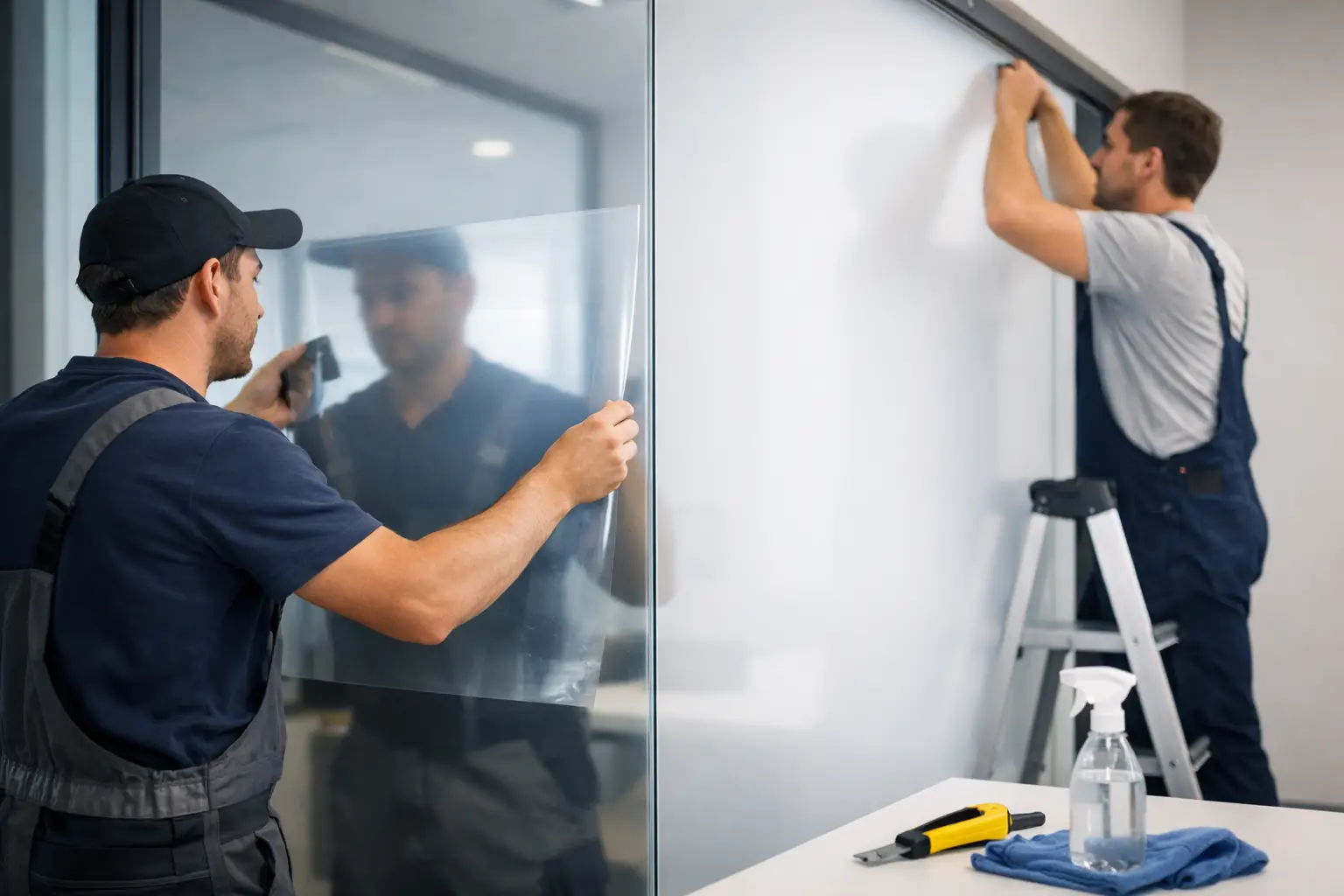
PDLC film installation for glaziers is not a standard decorative-film scope. The finished surface may look simple, but project success depends on decisions made before the liner is lifted: whether the existing glass is suitable, where power will terminate, how busbars will be concealed, and who owns final electrical commissioning. On qualified commercial projects, those details separate a clean privacy-glass installation from an expensive callback.
Retrofit PDLC film has a specific role. It converts suitable existing interior glass into an electrically controlled privacy surface. It is not a substitute for fabricated laminated smart glass where the assembly must tolerate wet exposure, exterior conditions, insulated-glass performance requirements, or a demanding long-term architectural environment. Glaziers who establish that distinction at the start protect the project, the design intent, and their own margin.
Start With the Correct Glass Path
Before measuring a single panel, confirm whether retrofit adhesive film is the right execution path. PDLC film is generally appropriate for existing, flat, interior glass where the substrate is in good condition and privacy-on-demand is the principal requirement. Office fronts, conference rooms, consultation rooms, executive partitions, and interior hospitality glazing are common candidates.
The condition of the existing glass matters. The viewing area should be free of chips, deep scratches, edge instability, failed coatings, and defects that will remain visible beneath the film. Film does not correct fabrication flaws or hide contamination trapped at the glass surface. It can make those issues more apparent, particularly under strong interior lighting.
Fabricated laminated smart glass should be evaluated instead when the project involves new glazing, shower enclosures, exterior-facing systems, high-humidity exposure, structural requirements, or details where the electrical components must be protected within a purpose-built assembly. This is not merely a product preference. It is a specification decision based on the operating environment and the responsibility expected of the finished system.
Confirm the System Can Accept Film
Existing glass-wall systems deserve particular attention. Verify panel dimensions, glass thickness, joint conditions, door clearances, hardware locations, and the available edge zone for electrical routing. A film panel that works on a fixed lite may not work on a swinging door without a defined flexible wiring strategy and suitable hardware coordination.
Also confirm which face of the glass will receive the film. The selected surface affects access, cleaning exposure, visual appearance, and protection from traffic. In most commercial interior applications, the preferred installation face is the one least exposed to abrasion and routine contact. That decision should be resolved with the architect, dealer, or project team before material is cut.
Pre-Installation Coordination Is the Real Work
The visible installation window is only one part of the scope. Reliable PDLC work begins with a field-verified drawing package that identifies every panel, finished film dimensions, busbar orientation, lead locations, controller locations, transformer capacity, switching method, and concealment details.
Do not treat electrical planning as an afterthought. Each panel requires a defined connection path, and the project needs enough accessible power capacity to serve the total load. A low-voltage power supply may be compact, but it still needs a code-appropriate location, ventilation as required by its specification, service access, and coordination with the responsible electrician. Controls may be as simple as a wall switch or as coordinated as a relay, automation interface, occupancy sequence, or room-control system.
The cleanest projects establish responsibility early. The glazier typically owns field measurements, substrate preparation, film placement, and visible finish quality. Electrical connection and line-voltage work should be assigned to qualified electrical personnel. The exact division varies by project and local requirements, but ambiguity does not improve after the glass is installed.
Measure the Finished Viewing Area, Not the Drawing Assumption
Field dimensions govern. Glass openings that appear repetitive on an elevation can vary due to system tolerances, mullion alignment, gasket conditions, or prior site adjustments. Measure each lite when the project demands a close visual reveal.
Allow for the intended edge treatment and avoid forcing film into irregular corners or against active gasket lines. A controlled, consistent setback is usually better than a nominally full-coverage cut that crowds the edge and creates a visible wavering line. Where busbars and leads are to be concealed behind trim, confirm that the trim actually provides enough depth without pinching conductors or preventing future service.
Prepare the Glass Like a Finish Surface
PDLC film will reveal shortcuts. Dust, adhesive residue, silicone transfer, fingerprints, and airborne jobsite contamination can create visible defects, reduced adhesion, or both. Installation should occur after heavy dust-generating work is complete whenever possible. If that sequence cannot be achieved, create a controlled work area and set realistic expectations with the project team.
The glass must be thoroughly cleaned with materials compatible with the film system. Follow the manufacturer-approved cleaning process rather than relying on general-purpose site cleaners, which can leave residues. Use lint-free wipes, clean squeegees, and fresh solution. Inspect under strong, angled light before installation begins.
Temperature and humidity also deserve attention. Extreme conditions can affect handling, adhesion behavior, and the time available to position the material. A conditioned interior environment is preferable. If the glass is cold from a recently opened exterior condition or wet from cleaning, allow it to stabilize completely before applying film.
Installation Requires Controlled Handling
Once the substrate is ready, handling discipline becomes the difference between an acceptable panel and a premium finish. Film should remain protected until the installer is ready to place it. Avoid folding, creasing, dragging, or resting the active surface on contaminated worktables. Use clean gloves where appropriate, and keep tools dedicated to the installation.
Placement should be deliberate. Establish the reference edge, confirm lead orientation one final time, and align the panel without rushing. The adhesive side should make contact progressively while the installer controls air evacuation with the specified application method. Excess pressure, aggressive squeegeeing, or repeated lifting and repositioning can damage the film, stress the busbar area, or create optical distortion.
Minor visual variation can occur with PDLC technology, especially when comparing panels under different lighting conditions. That does not excuse visible debris, creases, poor edge alignment, or trapped air. A commercial installation should be judged at normal viewing distance, under the actual project lighting, with both powered and unpowered states evaluated.
Protect Leads and Busbars
The electrical edge is not a detail to improvise in the field. Busbars, lead exits, and conductor routing must be protected from tension, abrasion, moisture, and pinch points. Maintain bend radii appropriate to the conductor and avoid routing wires where glass hardware, trim clips, or door movement can damage them.
Where multiple panels are grouped, label each lead during installation. Clear identification simplifies commissioning and prevents unnecessary troubleshooting once trim is closed. It also supports future service, particularly on conference-room fronts and other installations where access may be limited after turnover.
Commission Before Closing the Scope
PDLC film should be electrically tested before final concealment details are completed. Confirm that each panel switches uniformly from its default private state to the transparent state, that controls operate as intended, and that there is no unexpected flicker, delayed response, or incomplete activation.
Commissioning should include a visual review in both modes. In the privacy state, check for consistent opacity and confirm that no wiring, edge treatment, or substrate defect distracts from the intended presentation. In the clear state, review optical quality from primary approach angles. If a room-control interface is included, test the actual use sequence rather than only energizing the transformer.
Document the installed panel layout, power-supply locations, control assignments, and service access points. This reference discipline is particularly valuable when a tenant improvement team changes, an automation contractor arrives late, or a future facilities manager needs to identify a concealed component.
Quote the Scope You Can Control
For glaziers, PDLC film work should be quoted as a coordinated installation system, not simply as square footage. Labor exposure is influenced by panel count, access, after-hours constraints, surface condition, electrical routing, trim removal and replacement, control integration, and the level of finish expected by the design team.
A small conference room with six narrow lites may require more coordination than one large fixed panel. Likewise, a film-only price can become misleading if the project has no defined electrical path or requires custom concealment after the fact. Qualified commercial projects benefit from a clear scope that identifies assumptions, exclusions, and responsible trades.
Smartglass USA supports capable glazing and project partners with product-path guidance, fabrication coordination where laminated smart glass is the better fit, and technical review for serious execution paths. The objective is not to force retrofit film into every opening. It is to match the privacy-glass solution to the glass condition, architecture, and operating environment.
The strongest PDLC installations are rarely the ones completed fastest at the glass. They are the ones where the glazing team has verified the substrate, protected the electrical details, and handed over a privacy system that performs as deliberately as it was specified.