
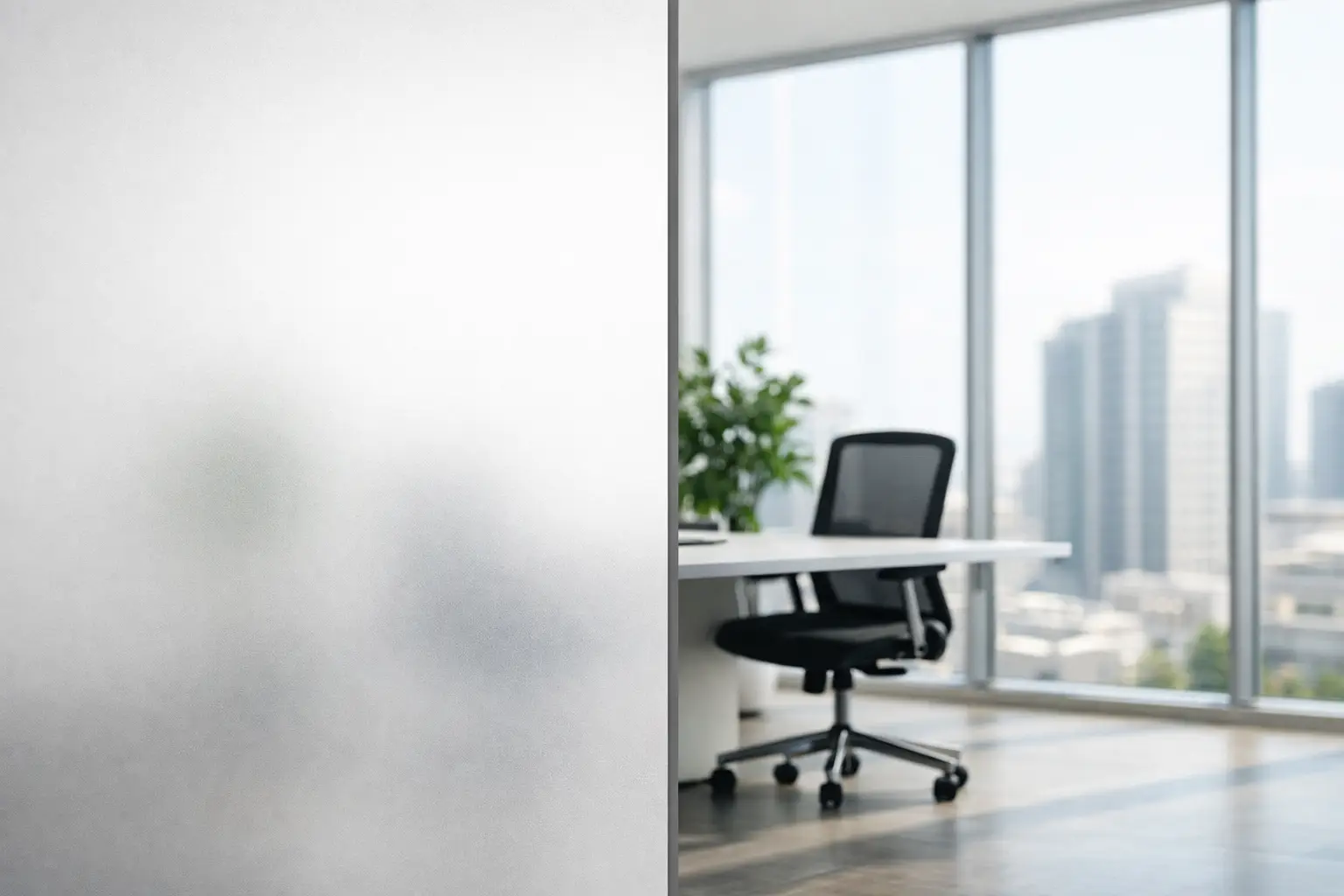
A conference room can look open and collaborative at 9:00 a.m., then need complete visual privacy for a client call at 9:15. That single operational requirement changes the decision between frosted glass versus switchable glass. Both obscure views. Only one allows the space to change its privacy condition without replacing the glass, adding a shade, or compromising the architectural intent.
For commercial teams, this is not simply a finish selection. It is a specification and execution decision that affects glazing scope, electrical coordination, controls, budget, maintenance expectations, and the long-term use of the room.
Frosted Glass Versus Switchable Glass: The Core Difference
Frosted glass provides permanent diffusion. It can be acid-etched, sandblasted, ceramic-fritted, laminated with an opaque interlayer, or treated with a decorative film. Once installed, its privacy condition does not change. It is a practical solution where continuous obscurity is the objective, such as restroom partitions, back-of-house areas, selected clinical rooms, or fixed visual screens.
Switchable glass uses a liquid crystal polymer-dispersed display, commonly called PDLC, within a laminated glass assembly or as a retrofit film applied to existing interior glass. When power is on, the PDLC layer aligns and the panel becomes transparent. When power is off, the layer scatters light and creates a translucent privacy state.
The distinction is simple: frosted glass is static privacy; switchable glass is controlled privacy. The right selection depends on whether transparency has operational value.
A design team that only needs screening should not force an electrically controlled solution into the project. Conversely, a team that needs open sightlines, borrowed light, and immediate privacy should not treat permanent frosting as an equivalent substitute. The visual result may be similar when switchable glass is in privacy mode, but the user experience is fundamentally different.
Where Frosted Glass Is the Better Fit
Frosted glass is often the correct choice when the room function is stable and privacy is non-negotiable throughout the day. It has no power requirement, no control wiring, and no smart-glass controller to coordinate. For straightforward partitions with a fixed privacy brief, it can offer a clean and economical execution path.
It also gives designers broad control over appearance. Gradient patterns, logos, striped bands, custom textures, and varying levels of translucency can support branding or provide code-conscious manifestation on glass partitions. Decorative films can be useful in lower-risk interior applications where the existing glazing is sound and the desired result is primarily visual.
However, permanent frosting has limits that should be acknowledged before it is specified. It removes clear views at all times. It may make a compact room feel more enclosed, and it can interfere with the visual connection that makes glass-wall systems attractive in the first place. In healthcare, executive, and hospitality spaces, the inability to restore transparency can be a daily operational compromise rather than a minor aesthetic issue.
Frosted surfaces can also reveal fingerprints, cleaning marks, or uneven wear differently than clear glass. The exact maintenance behavior depends on the finish, whether the treatment is on an exposed surface, and the cleaning protocol used on site. These details matter in high-touch environments.
When Switchable Glass Earns Its Scope
Switchable glass is justified when a glass partition must perform two jobs: preserve openness when privacy is not required, then provide obscurity on demand. Typical applications include conference rooms, executive offices, consultation rooms, clinics, hotel suites, luxury residential bathrooms, and premium hospitality settings.
In a meeting environment, transparent glass supports daylight distribution, passive visibility, and a more open floor plate. When confidential material appears on a screen or a sensitive conversation begins, privacy can be activated through a wall switch, remote control, automation platform, or room-control system. That control is the value proposition, not the novelty of glass that changes state.
The privacy state of standard PDLC is translucent rather than blacked out. It obscures views effectively, but it still transmits light and can reveal silhouettes when people stand close to the panel. Project teams should not represent it as a total light-blocking or security solution. Where room-darkening, solar management, or stronger concealment is required, the assembly may need complementary shading, a different glazing strategy, or a more detailed performance review.
Switchable glass also demands reference discipline. Panel dimensions, busbar locations, wire exits, framing details, electrical access, control zones, transformer placement, and field sequencing should be reviewed before fabrication or installation begins. A privacy-glass package can look simple in elevation while requiring careful coordination across glazing, electrical, drywall, millwork, and controls trades.
Retrofit Film or Fabricated Smart Glass?
This is the most consequential technical distinction for a qualified project.
Retrofit adhesive PDLC film is intended for existing interior glass where the glazing is already installed, structurally appropriate, and in good visual condition. It can be an effective path for office partitions, conference-room fronts, and other interior applications where replacing the glass would create unnecessary disruption. The film is installed on the glass surface, with electrical connections and edge details planned around the existing system.
Retrofit film is not simply a lower-cost version of fabricated smart glass. It has different visual, durability, and installation considerations. Surface preparation is critical. The substrate must be suitable, installation conditions must be controlled, and wire-routing options need to be identified early. It is generally not the preferred route for wet environments, shower glazing, exterior-facing applications, or installations that demand a fully integrated laminated glass construction.
Fabricated laminated smart glass places the PDLC layer within a purpose-built glass assembly. It is the appropriate path for new construction, replacement glazing, shower glass, higher-demand interior conditions, and applications where the smart layer needs protection within the glazing build-up. It allows the project team to coordinate glass thickness, safety-glazing requirements, edge treatment, hardware compatibility, and framing as part of one designed assembly.
For glaziers and fabricators, this distinction protects both the quote and the installation. Quoting retrofit film against a scope that truly requires fabricated laminated glass creates a mismatch in performance expectations and field responsibility. Quoting fabricated smart glass where existing interior glass can be retained may add cost and schedule impact without improving the project outcome. The decision should begin with existing glass versus new glass, not with a generic request for “smart film.”
Cost Should Be Measured Against Use, Not Just Material
Frosted glass generally has a lower initial material and coordination cost because it has no electrical system. That makes it attractive for broad areas of permanent screening. But lowest first cost is not always the lowest project cost when the room must remain flexible, premium, and visually connected to adjacent spaces.
Switchable glass carries additional costs for the PDLC component, power supplies, controls, electrical work, fabrication or installation complexity, and project coordination. Those costs should be evaluated against the space’s function. A boardroom used for confidential meetings, a medical consultation room, or a premium suite where privacy is part of the guest experience may justify the investment more clearly than a storage enclosure or a permanently private office.
The right commercial comparison asks: What happens when occupants need both transparency and privacy? If the answer is that they lower blinds, close curtains, apply temporary film, or avoid using the room for sensitive work, then the static solution may be creating recurring operational friction.
Specification Questions Before You Quote
Before selecting either material, establish whether the glass is existing or new, whether the location is dry or wet, and whether the privacy requirement is permanent or controllable. Confirm the intended control method, panel dimensions, glazing system, safety-glass requirements, access to power, and the party responsible for electrical rough-in and final connection.
It is also useful to clarify what “privacy” means to the client. Do they need obscured views, reduced silhouettes, room darkening, acoustic separation, or all of the above? Frosted and switchable glass address visual privacy. Neither replaces proper acoustical construction, and neither should be specified as a security barrier without an assembly-specific assessment.
For projects involving switchable glass, early review is usually less expensive than correcting an electrical or glazing conflict after walls are closed. Smartglass USA approaches these scopes as coordinated architectural packages, with the product path tied to the installation reality rather than a generic material request.
The best privacy-glass decision is the one that respects how the room will actually be used. When privacy never changes, permanent frosting can be disciplined and effective. When the room must alternate between openness and discretion, switchable glass gives the architecture permission to do both.