
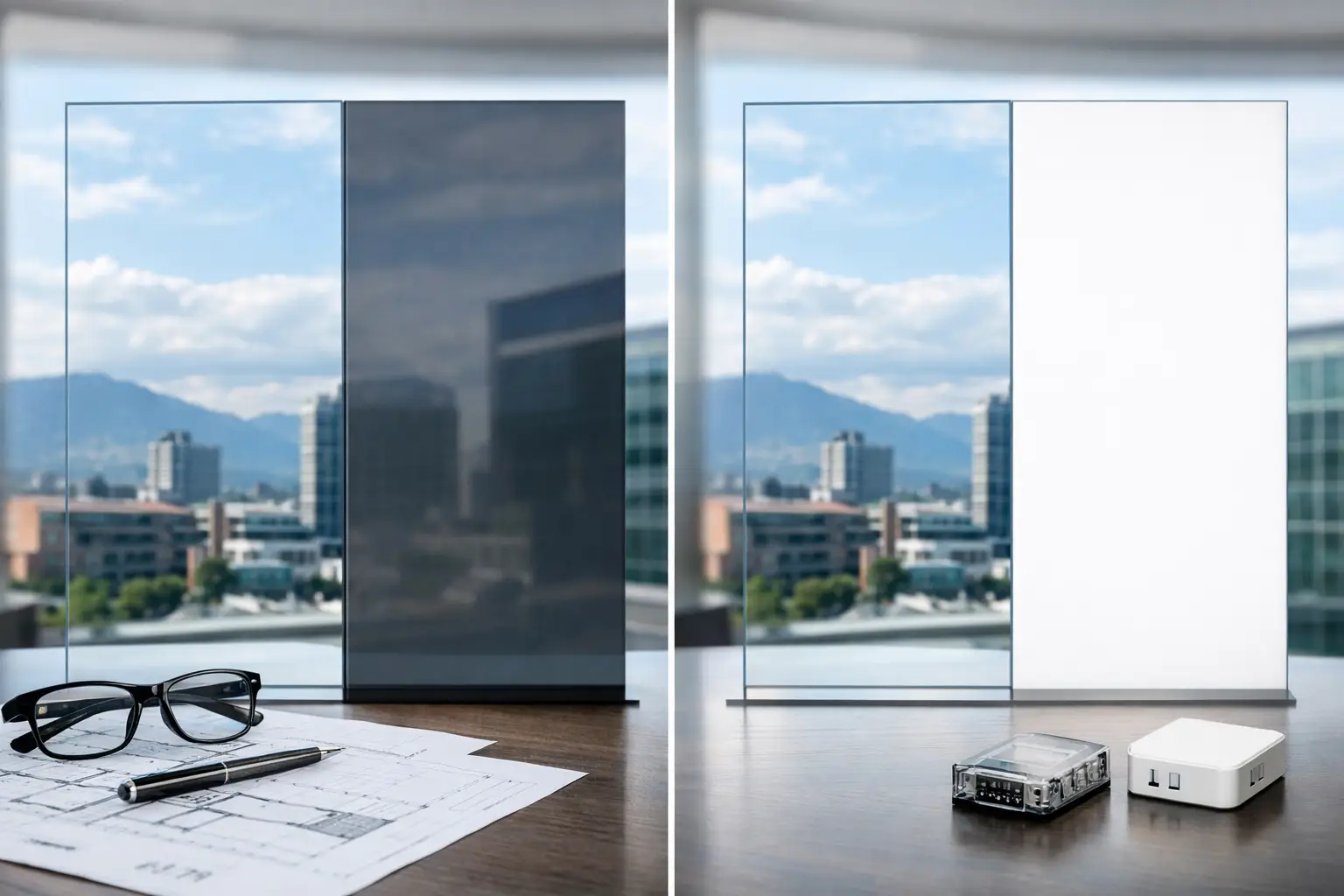
A conference room that needs instant visual privacy has a different technical requirement than a south-facing facade that needs to reduce glare and solar heat. That distinction is where electrochromic glass versus PDLC becomes a specification decision, not a product preference.
Both technologies use electricity to change the appearance of glass. Their operating behavior, fabrication path, control requirements, and design value are materially different. For architects, glaziers, glass-wall dealers, and project teams, selecting the wrong system can create a costly mismatch between the intended use and the installed result.
Electrochromic Glass Versus PDLC: The Core Difference
Electrochromic glass changes its tint. In a clear state, it resembles conventional glass. When activated, it transitions through increasingly darker states to manage daylight, glare, and solar gain. The glass remains visually transparent, although exterior views and interior light levels are reduced as the tint deepens.
PDLC, or polymer dispersed liquid crystal glass, changes visual clarity. In its standard configuration, PDLC is transparent when powered and turns white or frosted when power is removed. The frosted state disrupts the line of sight quickly, creating on-demand privacy while continuing to admit diffuse light.
That distinction should lead the conversation. Electrochromic technology is primarily a daylight and solar-control solution. PDLC is primarily a visual-privacy solution. A dark electrochromic pane may reduce visibility, but it does not reliably create the obscured, meeting-room-grade privacy that PDLC provides. Conversely, PDLC can create an effective privacy screen, but it is not designed to manage solar heat gain or glare on a high-exposure facade.
Start With the Project Condition
The first question is not which technology is more advanced. It is whether the project needs privacy, shading, or both.
For interior conference rooms, executive offices, healthcare consult rooms, hospitality suites, and premium residential partitions, PDLC is usually the more direct fit. The user wants a clear room when visibility supports collaboration and a private room when confidentiality matters. The visual response is immediate enough for practical daily use, and the frosted state is legible from across the space.
For exterior curtain walls, highly glazed elevations, skylights, and perimeter zones affected by changing sun conditions, electrochromic glass has a stronger rationale. Its purpose is to reduce glare and heat while preserving a relationship to the exterior. It is generally specified as part of a purpose-built glazing system rather than added to an existing interior pane.
Some projects legitimately require both functions. A premium workplace may use electrochromic insulating glass at the facade and PDLC within interior meeting rooms. Trying to make one technology perform both jobs often introduces compromise without solving either requirement cleanly.
Privacy Is Not the Same as Darkness
This is a recurring source of misquoting. A heavily tinted electrochromic panel can offer a degree of visual screening during daylight conditions, but people and interior activity may remain visible, particularly when the interior is illuminated at night. Backlighting changes the result substantially.
PDLC in its privacy state scatters light, so the glass appears opaque or frosted rather than dark. It will obscure faces, screens, and room activity, though it is not a black-out system. Shadows may still register near the glass, and the exact privacy performance depends on the panel construction, lighting, viewing angle, and installation details.
For clinical privacy, confidential meetings, shower applications, or spaces where occupants expect an unambiguous change from open to private, PDLC provides the more appropriate visual behavior.
Installation Path: Existing Glass or New Glass
The most useful PDLC distinction is retrofit versus fabricated. These are separate execution paths and should not be priced or detailed as interchangeable products.
Retrofit adhesive PDLC smart film is applied to suitable existing interior glass. It can be a practical route when a commercial interior is already built, the glass is in acceptable condition, and the project needs privacy functionality without replacing the glazing. The condition of the glass, accessibility, edge exposure, electrical routing, and finish expectations must be reviewed before this route is approved. Retrofit film is not a universal answer for every existing glass surface.
Fabricated laminated PDLC smart glass is manufactured as a glazing assembly. It is the appropriate path when the glass itself is being replaced, when the panel must meet demanding architectural conditions, or when the application includes wet areas, shower glass, custom fabrication, or more exacting edge and durability requirements. The PDLC layer is protected within the laminated assembly and coordinated with the required glass type, thickness, safety-glazing requirements, and framing system.
Electrochromic glass also follows a fabricated-glass path. It is normally integrated into insulating glass units or specialized assemblies and coordinated early with facade, glazing, electrical, and controls teams. It is not a comparable retrofit film option for an occupied office partition.
Controls and Electrical Coordination Change the Scope
Neither technology should be treated as ordinary decorative film. Both require electrical planning, but the load profile and control logic differ.
Standard PDLC requires power to remain clear. When power is removed, it returns to its frosted privacy state. That behavior can be useful for rooms where privacy is the default condition, but it must be understood during power interruptions and controls design. Panel sizes, busbar placement, wire exits, transformers, switching zones, access for service, and low-voltage routing all need coordination before fabrication or installation.
Electrochromic glass typically uses power during state changes and can hold a tint state with minimal ongoing energy use. It may be tied to wall controls, daylight sensors, building automation systems, occupancy settings, or facade-control strategies. The transition is gradual rather than instantaneous. Depending on the glass size, temperature, and selected system, the change may take minutes. That is appropriate for solar management, but it is not the operating expectation for a meeting room that needs privacy at the press of a button.
For both technologies, control intent should be documented early. A vague note stating “switchable glass” is not enough for a serious execution path. The project team should establish the desired default state, control zones, switching locations, automation requirements, electrical responsibility, and commissioning process.
Appearance, Performance, and Trade-Offs
PDLC delivers a clean architectural effect when specified and installed correctly, but clear-state optics are not identical to monolithic clear glass. Depending on the product and viewing conditions, there may be a modest haze or visual shift. This is often acceptable, and even desirable, in privacy applications. It should still be reviewed with the design team rather than assumed away.
Electrochromic glass offers a more refined response for view preservation and daylight control, particularly in exterior applications. Its trade-offs include higher system complexity, longer lead times, coordination with facade performance requirements, and a more involved controls scope. The color and tint range should be evaluated in context with adjacent glazing, interior finishes, and expected sky conditions.
Cost comparisons require similar discipline. A square-foot comparison can be misleading when one product is a retrofit layer on existing interior glass and the other is a fabricated insulated assembly with controls and facade coordination. The relevant comparison is total installed project scope: glass, framing, electrical work, controls, labor, commissioning, and the operational value of the finished space.
How to Specify the Right Direction
A qualified project review begins with the glass condition and the intended user experience. Is the glass already installed, or is this new construction? Does the client need true visual privacy, glare control, or a combination of separate systems? Is the application interior, exterior-facing, wet, or subject to code and safety-glazing requirements? Who owns electrical rough-in and final controls integration?
It is also worth reviewing mockups or representative samples under the actual lighting conditions. An interior partition may look excellent in a showroom yet perform differently against a bright exterior backdrop or under after-hours lighting. For high-visibility commercial spaces, reference discipline protects both the design intent and the installation team.
Smartglass USA approaches this decision through the actual assembly and installation path, not a generic product pitch. Existing interior glass may support a retrofit PDLC film solution. New partitions, shower glass, and demanding architectural conditions may call for fabricated laminated smart glass. Exterior solar-control goals require a separate electrochromic conversation with the appropriate glazing and controls coordination.
The right choice is the one that lets the finished glass do one job exceptionally well. Specify PDLC when privacy must be immediate and convincing. Specify electrochromic glass when daylight, glare, and exterior comfort are the governing concerns. When a project needs both, keep the functions clear, coordinate them early, and give each glass system the execution discipline it requires.